Friday, November 23, 2012

How To Memorize The Quran


So, this hifz technique was taught by the Algerian Shaykh Zakariya al-Siddiqi who teaches at the Institute of Human Sciences in France and is one of the foremost scholars of Quran today.
He memorised it by the age of 9 and dedicated his life to studying and teaching it, and he once told us the story of one of his friends. His friend was an engineering student, who was a ’Fresher’ about to embark on a 5 year degree. Let’s call him Ahmed…
Ahmed was an intelligent student who followed one of the oft-forgotten Sunnah’s of Success…
Quran Memorization Tip 1: Wake Up Early
He woke up earlier than most people. In fact, he woke up on time to get to the Mosque to pray Fajr every day. When he got home from the mosque, instead of busying himself with the internet or watching television, he spent the first few minutes of each day memorising the Quran.
Quran Memorization Tip 2: Each Day Memorise Less Than You Think You Can
Ahmed made a firm commitment to memorise the Quran, but instead of rushing in and trying to memorise one or two pages each day (like his friends who gave up before long), he confined himself to learning 5 lines per day.
This worked out to be about 20-30 minutes per day for him.
Quran Memorization Tip 3: Get Familiar First
In order to overcome the initial unfamiliarity with the new verses, he spent the first few minutes each day actually writing out the 5 lines of that day onto a small sheet of paper.
He spent the next few minutes reciting them over and over, and then attempted to memorise them.
Quran Memorization Tip 4: Keep Today’s Verses Close At Hand
As Ahmed went about his day, he often found that he had a few chunks of time – several minutes each. During these times, such as waiting for the bus, or waiting for a teacher to turn up to a class, Ahmed would try to remember the 5 lines from that morning.
To aid his memory, he kept the sheet that he wrote out that morning folded in his pocket, and would pull it out if he was struggling.
Quran Memorization Tip 5: Use What You Memorise In Every Single Salah
To further support his memory, every prayer he prayed that day, he would recite the same 5 verses of Quran that he learned that morning. In each aka’, he would alternate between the 5 lines from that day, and the 5-10 lines he learned the previous days. And remember…
Quran Memorization Tip 6: Keep Track Of Your Goal
With the Uthmani script of the Quran, there are exactly 15 lines per page. So, by the end of the week, Ahmed had not only memorised 2 whole pages of the Quran, but he had written them out in full, too… a very blessed act if ever there was one.
Quran Memorization Tip 7: Perfect Your Tajweed As You Go
On the weekend, Ahmed would visit a local scholar of Quran recitation, and would revise with him the 2 pages he had just memorised, and have a go at the 2 pages he would be working on the following week. This way, he was certain to learn the Quran with accurate tajweed and beautiful recitation.
There was one other secret to Ahmed’s success.
The Spiritual Secrets Of Successful Memorisation… 
Once a week, on a weekend evening (usually on a Friday night), Ahmed would wake up in the middle of the night, and pray Tahajjud. During his special Tahajjud prayer, Ahmed would recite the whole two pages he had learned that week, and consolidate them.
At this point, the Shaykh mentioned that perhaps one of the reasons so few people manage to wake up and do this special prayer, which is highly recommended by the Quran and by our beloved Prophet (saw), is that we don’t have anything to recite.
We have so little Quran memorised that there’s no fun or enjoyment in the challenge of waking up for Tahajjud, and we often find even the fard prayers a ’chore’ instead of a pleasure.
The Results…
You can imagine Ahmed’s excitement and feeling of achievement and success 3 months after he started, when he had memorised the entire 1st Juz!
It’s not just the feeling of success and empowerment that the Quran gave him, but also the deep connection with Allah (SWT) he felt every single day.
You can only imagine how proud he must have felt of himself, when upon graduation Ahmed not only received a 1st class degree in engineering (he was 3rd in his class), but he had also officially memorised the entire Quran. He was a hafidh.
Shaykh Zakariya pointed out a final lesson from this blessed brother.
The biggest achievement he made was not to memorise the Quran. The biggest achievement he made was to be deeply connected with the Quran every single day for 5 years.
That connection with Allah (SWT) is what made Ahmed so special. That deep link with the Creator is what keeps life in perspective and is what helped Ahmed to keep on track with the little weekly targets he set for himself.
One can only imagine what happened to Ahmed’s levels of personal fulfilment, Imanand taqwa, as he went back every single day to develop this ritual of ihsan (spiritual excellence). Each day he woke up for Fajr and wrote out another 5 lines of Quran, his self-esteem and self-confidence soared…
“Can the reward for excellence be anything other than excellence?” Surah Rahman (55: 60)

Quran Memorization techniques


Bismillah, alhamdulillah wa salat wa salam ala Rasulullah
Quran Memorization techniques

Day 1
Copy out the page of the Quran that you want to memorize.
Read it until you get a fluent at it and have it memorized a little.
Repeat what you memorized 500 times (yes you read that right). You will occasionally read it while looking at the text. But go easy on yourself and take breaks in between. Use a misbah (rosary beads) to keep track and take breaks between every 100. It will take about 4.5 hours to do this if it is one page of Quran that takes about one minute for once through.
Day 2
Do the exact same as Day 1 for the new material (copy out the text, memorize, repeat 500 times).
Return to Day 1’s material and repeat it 150 times.
Day 3
Do the exact same as Day 1 for the new material (copy out the text, memorize, repeat 500 times).
Return to Day 2’s material and repeat it 150 times.
Return to Day 1’s material and repeat it 50-75 times.
Day 4
Do the exact same as Day 1 for the new material (copy out the text, memorize, repeat 500 times).
Return to Day 3’s material and repeat it 150 times.
Return to Day 2’s material and repeat it 50-75 times.
Return to Day 1’s material and repeat it 10 times.
Day 1: 500 reps
Day 2: 500 reps+150
Day 3: 500 reps+150+75
Day 4: 500 reps+150+75+10
Day 5: Same as Day 4 but read everything together a few times to ensure proper connections are made.
Benefit of this method is that you do not have to review so much. But doing this method means you will hear the verses repeating themselves in your head and even dream of reciting them due to the intensity of it. The merit of this method is it is GUARANTEED in sha Allah!

Tuesday, November 20, 2012

Shaykh Ahmad an-Najmî about al-’Arifi: “It is not allowed to listen to storytellers”


Scholar: ´Allâmah Ahmad bin Yahyâ an-Najmî
Source: http://z-salafi.com/v2/zsalafi.php?s_menu=23&idFatwa=1213
Reference: Darulhadith.com
http://aFatwa.com
Question: Is it allowed to listen to Shaykh Muhammad bin 'Abdir-Rahmân al-'Urayfî?
Shaykh an-Najmî: It is not allowed to listen to storytellers. It makes the humans gather around them, which is inappropriate.

[Must Watch] Muhammed Al Arifi Surah Tu’faaha Mockery Addressed By Shaykh Ubayd & Shaykh Al Fawzaan


[Must Watch] Muhammed Al Arifi Surah Tu’faaha Mockery Addressed By Shaykh Ubayd & Shaykh Al Fawzaan 

Note : Muhammad Al-’Areefi is the author of the popular book “Enjoy Your Life!“

The Day of Aashoora - Lessons Fasting Merits – Dr. Saleh as Saleh [Mp3|En]

Online Class - Sharhus Sunnah (Imaam Barbaharee) - Mustafa George - 18 November 2012


Basmallah.jpg
WasSalaatu WasSalaamu ‘Alaa RasooliLLAH
As salaamalaikum Wa RahmatuLLAH


Sunday, Nov 18, 2012|9:30 PM (+4 GMT)

This online class will be delivered by the brother Abu Ismail Mustafa George, held every Sunday at 9.30 pm (+4 GMT) insha Allah.

It will cover the book 'Sharhus Sunnah' of Imaam Barbaharee.

Excerpt from the book:
Know that Islam is the Sunnah, and the Sunnah is Islaam, and one of them cannot be established without the other.

We ask Allah to Bless us with the ability to act upon what we learn.


Logo.jpg

Tuesday, October 23, 2012

Can People See The Angels?


Questioner: Can people see the angels?
Al-Albaani: In the form Allaah created them in, no. In forms which they may imitate, then of course.
And Ai’ishah, may Allaah be pleased with her, and others saw Jibreel in the form of Dihyah al-Kalbi. As for seeing Jibreel in his original form, then that was not granted to anyone except the Prophet صلى الله عليه وسلم.
Al-Hudaa wan-Noor, 322.

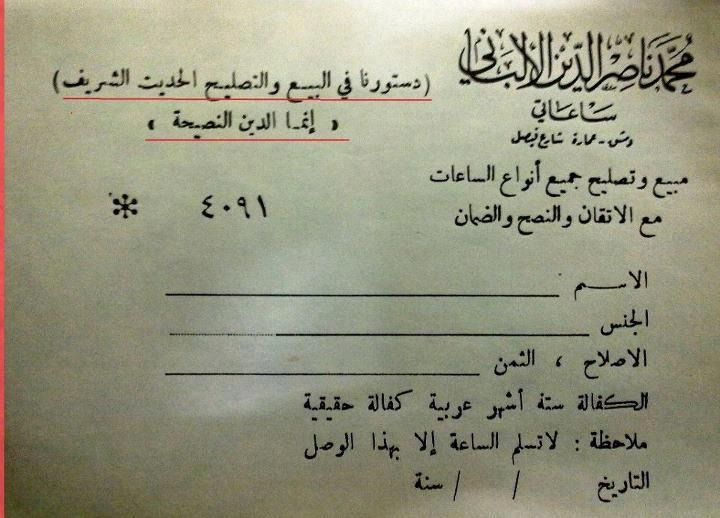
A Picture of a Receipt from the Shop of Al-Albaani the Watch-Repairer


Watch Repair Receipt
Muhammad Naasirud-deen al-Albaani
Horologist
Damascus, Al-Amara district, King Faisal Street
[a famous district and street in Damascus]
Our code [motto] in selling and repairing is the noble hadith,
“The religion is to sincerely advise.”
Sale and Repair of all Types of Watches
With Precision, Sincere Advice, and Guaranteed
Name:
Sex [/or maybe type of watch]:
Repair and cost:
Guaranteed for six Arabic months, with a real warranty.
Note: Watches will not be returned except with this receipt.
Date:        /         /        year

The Shaikh on the Hadith, “Du’aa is worship …”


Explaining the hadith, “Du’aa is worship …” Shaikh al-Albaani, may Allaah have mercy on him said, “And there is no doubt that arrogantly refusing to worship and supplicate to Him, the Most High, necessitates His Anger against the one who does not call on Him … and some of the ignorant Sufis are ignorant or feign ignorance of these hadiths under the assumption that supplicating to Allaah is to show bad manners to Him, being affected in that by the Israa’ili narration, ‘His Knowledge of my condition suffices me from having to ask!’  So they were ignorant of the fact that a servant supplicating to his Lord is not in order to inform Him of his need, for He, “… knows the secret and what is [even] more hidden,” [Taa Haa 20:7] but rather that it is in order for him to manifest his servitude [to Allaah], his need of Him and his destitution [before Him].”
As-Saheehah, 6/326.

Al-Albaani’s Daughters Mentioning Their Father’s Answer to a Question About Memorising the Quraan


In their book, Hassaanah and Sukainah, the daughters of Shaikh al-Albaani said, “And our father, may Allaah have mercy on him, was asked, ‘If I have memorised a quarter of the Quraan and then I move on to the second quarter [but] I haven’t memorised the previous quarter properly, will I be sinful?’ So he replied, ‘You won’t be sinful inshaa Allaah, but you would not have responded appropriately to the Prophet’s صلى الله عليه وسلم saying, “Keep refreshing your knowledge of the Quraan, for by the One in Whose Hand is the soul of Muhammad, it is more inclined to escape than a camel from its rope,” [Muslim] in this hadith is an encouragement to refresh one’s knowledge of the Quraan and to be persistent in reciting it, because it escapes from the breasts of men due to the loftiness of Allaah the Mighty and Majestic’s Speech and its exaltedness.’”
Ad-Daleel ilaa Ta’lim Kitaabil-Laahil-Jalil, vol.3, p. 127.

Why Shouldn’t Allaah be Asked About What He Does?


“Because of Allaah, the Most High’s, Wisdom and Justice in His Judgements, it is not for anyone to ask about what He does, because all of His Judgements, the Most High, are unequivocally just, so there is no need to ask.”
As-Saheehah, vol. 1, p. 117.

Shaikh Mashoor Hasan, may Allaah protect him, said, “A student of the Shaikh, the Allaamah, the Faqih of his time, Ibn Baaz, may Allaah have mercy on him, visited me, being very enthusiastic about meeting our Shaikh al-Albaani, may Allaah have mercy on him. When I asked him why he was so eager, he said, ‘I heard my Shaikh, Shaikh Ibn Baaz, may Allaah have mercy on him, saying: ‘We spent our time with the speech of the scholars of fiqh [the fuqahaa], and al-Albaani spent his time with the hadiths of the Prophet صلى الله عليه وسلم.’’” From this tape, at 22:40.


Shaikh Mashoor Hasan, may Allaah protect him, said, “A student of the Shaikh, the Allaamah, the Faqih of his time, Ibn Baaz, may Allaah have mercy on him, visited me, being very enthusiastic about meeting our Shaikh al-Albaani, may Allaah have mercy on him.  When I asked him why he was so eager, he said, ‘I heard my Shaikh, Shaikh Ibn Baaz, may Allaah have mercy on him, saying:
‘We spent our time with the speech of the scholars of fiqh [the fuqahaa], and al-Albaani spent his time with the hadiths of the Prophet صلى الله عليه وسلم.’’”
From this tape, at 22:40.

Asking for Paradise Seven Times a Day


From Abu Hurairah who said, “The Prophet صلى الله عليه وسلم said, ‘No servant seeks refuge from the Fire seven times in a day except that the Fire says, ‘O Lord! Indeed your servant, [called] so and so, has sought refuge with You from me, so grant him refuge. And no servant asks Allaah for Paradise seven times in a day except that Paradise says, ‘O Lord! Indeed your servant, [called] so and so, has asked for me, so make him enter Paradise.’’”
Shaikh al-Albaani, may Allaah have mercy on him, said, “This hadith is authentic without doubt.
A point of benefit: Some people in Damascus and other places have made it a habit to seek refuge seven times as mentioned in the hadith loudly and in one voice after the morning prayer, and that is something which I know of no basis for in the pure Sunnah, and nor is this hadith suitable for them to draw upon [for saying it loudly and in unison] because it is unrestricted and is not limited to the morning prayer or the jamaa’ah, and it is not allowed to limit what the Wise Legislator has left unrestricted just as it is not allowed to make unlimited what He has restricted, for all of that is legislation which is specific to the All-Knowing, the All-Wise.
So let whoever wants to act upon this hadith do so at any time of the night or day, before the prayer or after it–and that is a pure/unadulterated following [of the Sunnah] and pure sincerity, may Allaah the Blessed and Most High grant us it.”
As-Saheehah, vol. 6, pp. 22-23.

A Forgotten Sunnah: Two Units of Prayer After an Argument


From Abu Hurairah, may Allaah be pleased with him, in marfoo’ form, “The expiation for every argument/dispute is two units of prayer.”
As-Saheehah, vol. 4, p. 397.

Tuesday, October 16, 2012

O you who have believed, enter into Islam perfectly (extract from Tafsir As-Sa'dee rahimahul-llah)

 Imam Abdur-Rahman bin Naasir As-Sa'dee rahimahul-llah (died 1376) said in his tafsir of verse 208 in Suratul-Baqarah: 

{O you who have believed, enter into Islam completely [and perfectly] and do not follow the footsteps of Satan. Indeed, he is to you a clear enemy}

This is a command from Allah the exalted to the believers, that they enter {into Islam completely} ie in all the legislation's of the religion, and that they do not abandon any of it, and that they do not be like he who took his desire as his God; if the legislated matter conformed with his desire he preforms it and if it opposed it he abandons it. Rather, the obligation is make the desire subordinate to the religion, and that he preforms all acts of goodness he is able to perform, and that which he is incapable of doing he intends doing it and remain committed to it so that he achieves it by his intention.

And hence entering into Islam completely is impossible and inconceivable without opposing the ways of the devil, He said {And do not follow the footsteps of Satan} ie by falling into disobedience of Allah. {Indeed, he is to you a clear enemy} and the clear enemy will only command evil and immorality and what harms you.

And At-Tabaree said: {completely} ie enter all of you into Islam. 

And there is no contradiction between the two explanations. For that it is reasonable to say: the command is that you all enter into all legislations of Islam. (Shaykh Rslaan)

Arabic text: 

{ 208 - 209 } { يَا أَيُّهَا الَّذِينَ آمَنُوا ادْخُلُوا فِي السِّلْمِ كَافَّةً وَلا تَتَّبِعُوا خُطُوَاتِ الشَّيْطَانِ إِنَّهُ لَكُمْ عَدُوٌّ مُبِينٌ} .
هذا أمر من الله تعالى للمؤمنين أن يدخلوا { فِي السِّلْمِ كَافَّةً } أي: في جميع شرائع الدين، ولا يتركوا منها شيئا، وأن لا يكونوا ممن اتخذ إلهه هواه، إن وافق الأمر المشروع هواه فعله، وإن خالفه، تركه، بل الواجب أن يكون الهوى، تبعا للدين، وأن يفعل كل ما يقدر عليه، من أفعال الخير، وما يعجز عنه، يلتزمه وينويه، فيدركه بنيته.
ولما كان الدخول في السلم كافة، لا يمكن ولا يتصور إلا بمخالفة طرق الشيطان قال: { وَلا تَتَّبِعُوا خُطُوَاتِ الشَّيْطَانِ } أي: في العمل بمعاصي الله { إِنَّهُ لَكُمْ عَدُوٌّ مُبِينٌ } والعدو المبين، لا يأمر إلا بالسوء والفحشاء، وما به الضرر عليكم.

The one who intends to do a sacrifice should not cut his hair and nails from the beginning of Dhul-Hijjah


Shaykh Al-Albaanee, may Allah shower His Mercy upon him, states in our of his works:
The Messenger of Allah, sallallahu alayhi wa sallam said:
‘When the new moon of Dhul-Hijjah appears and one of you wants to do the sacrifice, then he should abstain from (cutting) his hair and his nails.’
And in a narration:
‘Then he should not take anything from his hair or from his nails until he sacrifices.’
 – Mukhtasar Saheeh Muslim No.1251 and other than it.
Shaykh Al-Albaani, may Allah shower his Mercy upon Him, comments:
"I say: And the apparent meaning of the hadeeth is the obligation to leave removing the hair and the nails for the one who has resolved to do the sacrifice until he sacrifices ... and this is what Imaam Ahmad and other than him have said.
So, let those who are afflicted with the shaving of the beard pay attention to this, for indeed shaving it (the beard) for ‘Eed has in it three acts of disobedience:
The First: The shaving in of itself, for indeed it is to become feminine and to resemble the disbelievers and to change the creation of Allah as I have explained it in my book Adaab-uz-Zifaaf Fis-Sunnatil-Mutahharah (6th Edition, page 118).
The Second: Beautifying (oneself) for the ‘Eed through the disobedience of Allah!
The Third: What this hadeeth has benefitted with from the forbidding of taking (from) the hair for the one who wants to sacrifice. And in reality, very few are those who are saved from these violations (of the religion), even some of the people of knowledge! We ask Allah for safety.”

HJC: 'Eed al-Adh.haa – Friday 26 October 2012 Official Decision and Announcement of the High Judiciary Council of Saudi Arabia...


Just a short time ago, we were informed of the official decision and announcement of the High Judiciary Council (HJC) of Saudi Arabia regarding the beginning of Dhul-Hijjah.
 
1 Dhul-Hijjah will be on Wednesday 17 October 2012, and the Muslims performing Hajj will be in 'Arafah on Thursday 25 October 2012 (9 Dhul-Hijjah 1433), and the Muslim Ummah shall be celebrating 'Eed al-Adhaa on Friday 26 October 2012, (10 Dhul-Hijjah 1433), inshaa.-Allaah.

Saturday, October 6, 2012

Fear Allah Upon Knowledge!!! – Ash-Shaykh Hasan Abdil-Wahhaab Al-Bannaa


Al-Waalid, Ash-Shaykh Hasan Abdil-Wahhaab Al-Bannaa, hafidhahullahu ta’aalaa, said that -
the people dont fear Allah because they do not know Him. They are ignorant of Allah so therefore the do not fear Him. The one who is ignorant of Asmaa Allah wa Sifaatihi (Allah’s names and His Attributes) does not fear Allah. The one who does not know that Allah is fauqa Arshihi (above His Throne) does not fear Allah. The one who does not know Shurootu Laa Ilaaha Illa Allah (the conditions of Ash-Shahaadah) does not fear Allah. The one who knows Allah, who has knowledge of Allah’s Names and Attributes, the one who knows the conditions of Kalimatut-Tawheed (the state of the Oneness of Allah), the one who knows where Allah is; this is the one who fears Allah.

Throwing Dirt in the Face of the One who Praises You


Questioner: Is it correct for the one who is praised to throw dirt in the face of the person who praises him?

Shaykh Sulayman Ruhaylee: Praising a person in their face is of different types. Thefirst type is praising with lies. Thus he praises the person while he is untruthful, and this is not permissible. He says: “You have this and that quality.” And everything he says is in contradiction to the truth. (He says) “You are; MashaAllah, a man known for truthfulness.” While in reality this person is the biggest liar there is. (He says) “Masha Allah, you do not backbite the Muslims.” While in reality the person does not sit in a gathering except that he backbites. This is not permissible.
The second type is to justifiably praise the person, when the person is not safe from this being a fitna for them. He praises the person in their face, justifiably, while the person is not safe from this praise being a fitna for him, such that it is feared that this may beguile him; as we mentioned in the lesson concerning praise. This type of praise is not permissible. And the one who praises him has cut his neck. And if you find those who praise the people throw dirt in their faces. This is the category (who has dirt thrown in their faces)
The third type is to praise the person in their face while they are safe from this being a fitna for them. There is no harm in this type of praise; as was done by the Prophet prayers and peace are upon him, with Abu BakrAsSiddiq, may Allah be pleased with him, and with Umar, may Allah be pleased with him.
The fourth type is to praise the Muslim for qualities that he possesses behind his back. And this is desired. To spread the virtues possessed by a Muslim this is something which is desired.
Explained by Shaykh Sulaymaan Ar-Ruhaylee (hafidhahullaah)
Translated by Rasheed ibn Estes Barbee 

Lessons of Creed Acquired From The Hajj – By ‘AbdurRazzaq bin ‘Abdul-Muhsin al-Badr by AbdurRahman.org