Monday, December 24, 2012

Do Not Be Deceived By Ahlul-Bid'ah who may agree with the Salafees in certain matters


Bismillaah Al-Hamdulillaah wa salatu wa salaamu ‘ala rasulullaah
Amma-ba’d
Direct your attention, in-sha`Allaah, toward a specific part of the well known hadeeth of Hudhayfa ibn al-Yamaan (radiallaahu Ta’aala ‘anhu):
“…I (Hudhaifah) said: “Will there be any good after that evil?”
He (sallallaahu ‘alayhi wasallam) said, “Yes, but therein will be Da`khan (a hidden evil).
I asked: What will be the evil hidden therein?
He said: (That time will witness the rise of) the people who will adopt ways other than mine and seek guidance other than mine. You will know (their) good points as well as (their) bad points.
Student Abu ‘Abdis-Salaam (hafidhahullaah) said: “(Meaning) you will see things from them which you will acknowledge and accept, and you will see from them things which you will disapprove of. So we understand from this, ya ‘Ibad-ullaah (oh slaves of Allaah), that just because there comes from a person who is upon dalaala (misguidance) something that agrees with the haqq (truth) it equates to nothing so long as they are upon the guidance other than the guidance of the Prophet (salallaahu ‘alayhi wa sallam).
Because the Prophet (salallaahu ‘alayhi wa sallam) said that, in describing the deficiency of the people who will seek guidance with a guidance of other than the guidance of the Prophet (salallaahu ‘alayhi wa sallam). We will see certain things that we will acknowledge and accept, and we will see certain things that we will deny and reject.” [1]
Imaam Ibn Qayyim (rahimahullaah Ta’aala) said:
If bid’ah only consisted of lies, then it would NOT have been accepted and everybody would even hurry to condemn it and refute it. And if it only consisted of Haqq (truth), then it would not have been a Bid’ah, rather, in agreement with the Sunnah. But it (Bid’ah) consists of both truth and lies in which the truth is clothed with lies.
He (Allaah) Ta’aala said:
وَلاَ تَلْبِسُوا الْحَقَّ بِالْبَاطِلِ وَتَكْتُمُوا الْحَقَّ وَأَنْتُمْ تَعْلَمُونَ
And do not mix the truth with falsehood or conceal the truth while you know [it].
(al-Baqarah, ayah 42).”
[as-Sawaa´iq al-Mursalah (3/925)]
Mufaddal ibn Muhalhal – rahimahullaah – said:
If the heretic (person of bid’ah) started mentioning his bid’ah right at the beginning of the sitting, you would be on your guard and flee from him. But what he does is begin by mentioning hadeeth from the Sunnah, then, he slips his bid’ah in on you. It might then stick to your heart, but when will it leave your heart?” [Ibn Battah, Al-Ibaanah Al-Kubraa, 2:444]
Also, our father Shaikh Rabee’ bin Haadee al-Madkhalee (hafidhahullaah Ta’aala) said:
“Don’t say about a man who opposes the manhaj of the Salaf that he is a ‘Salafee.’ No, don’t say about a man who opposes the manhaj of the Salaf that he is a Salafee.
Don’t say that a man is ‘Salafee’ until you are sure that he is upon the manhaj [of the Salaf]. He is honored by it, and calls to it. He loves and unites based upon it, and hates and separates because of it. This is a Salafee. But someone who claims that he is ‘Salafee,’ and defends Ahlul-Bid’ah, and defends them against Ahlul-Sunnah, this is not a Salafee whatsoever. Whoever he is – Arab or non-Arab, in the East or in the West – because Salafiyyah has special qualities.
Salafiyyah has signs. Salafiyyah has affairs that differentiate its people from others in Walaa` and Baraa`, and ‘Aqeedah and Da’wah, and the stances that they take.” [2]
Shaikh Muhammad bin Ramzaan Al-Haajiree (hafidhahullaah) said:
What are the characteristics of the person of the Sunnah?
His ‘aqeedah (belief). His worship. His following [of the Prophet, salallaahu 'alaihi wa sallam]. His da’wah (his call), his invitation. His character, mannerisms. His transactions, his dealings with the people. This is the person of the Sunnah. His ‘aqeedah is correct, and it’s based upon following the Prophet (salallaahu ‘alaihi wa sallam). His worship is like that of the Prophet (salallaahu ‘alaihi wa sallam). His calling or invitation is likewise (upon the Sunnah of the Prophet, (salallaahu ‘alaihi wa sallam))…” [3]
Shaikh Ahmad Al-Bazmool (hafidhahullaah) said:
“And from the most important matters, in my view, that the Salafee youths must pay attention to, is that a person should Not be described as a Salafee because he has speech relating to an issue from the issues of Salafeeyah. (Yet at the same instance) we neither know his stance pertaining to other issues of Salafeeyah, nor do we know the methodology that he is upon. And it is possible that some of those who oppose (Salafeeyah) may agree with the Salafees (in certain matters).” [4]
Shaikh Muhammad Bazmool (hafidhahullaah Ta’aala) summarized the principles of Salafiyyah into four, from which other principles stem:
  1. Al-Ikhlaas
  2. Following the Sunnah (taking Allaah’s Messenger (salallaahu ‘alayhi wa sallam) as Imam in ‘Aqeedah, Manhaj, manner of worship, character)
  3. Warning against bid’ah and its people
  4. Sticking to the Jama’ah, and not dividing (and not revolting). [5]
So these are the Pillars/Principles of Salafiyyah, such that if an individual removes one from himself, he has removed himself from Salafiyyah, similar to that of a person who did not sit between the two sajdas, then he has no salat, and similar to that of a person who in wudhu did not wash his hands after his face (with the excuse “I already washed my hands in the beginning”), then he has no wudhu. 

So do not be deceived just because an individual:- knows the conditions of La illaaha il Allaah
- teaches Qur`an, or memorized Qur`an
- teaches hadeeth, or memorized 40 Nawawee
- teaches ‘Aqeedah
- combines the prayers when it rains
- knows the principles of fiqh
- quotes from some of the Salafee scholars
A Kharijee Takfeeri who has memorized the conditions of La illaaha il Allaah is still a Kharijee Takfeeri.
A grave-worshipping Soofee or Deobandi or Barelwee who teaches Qur`an, or memorized Qur`an is still a grave-worshipping Soofee or Deobandi or Barelwee.
An Ikhwaanee who revolts against the rulers and calls to democracy and at the same time this revolter teaches hadeeth is still an Ikhwanee who calls to democracy and revolts against the rulers.
A Tahreeri or Suroori who gives sadaqah is still a Tahreeri or Suroori.
A Qadari who prays with his hands on his chest is still a Qadaree.
An Ash’aree or Jahmee or Mu’tazilee who teaches ‘Aqeedah is still an Ash’aree or Jahmee or Mu’tazilee who rejects Attributes of Allaah, so flee from his ‘aqeedah classes! A Tableeghi who belives in Wahdat al-Wujood, and uses miswak is still a Tableeghi who belives in Wahdat al-Wujood. A Raafidee who drinks with his right hand is still a filthy Raafidee.
So don’t be deceived, ya ‘Ibadullaah!
Allaah knows best. And our final supplication is Al-Hamdulilaah.

Did Shaikh Al-Albaanee invent the term Salafi? - Abu Muadh Taqweem Aslam [Audio English]


Published on Nov 29, 2012 by AlbaseerahBradford
Listen and find out…
Taken from the series Be a Salafi Who is Earnest upon the Path (lesson 4) taught from the book of the same title by Abu Muadh Taqweem. The lesson is available from http://audio.albaseerah.com

Stories of non-human living beings that loved Muhammad (Sallalahu Alahi wa Sallam)


Date Palm Tree:
Narrated Jabir bin ‘Abdullah radi Allahu anhu:The Prophet sal Allahu alayhi wa sallam used to stand by a tree or a date-palm on Friday. Then an Ansari woman or man said. "O Allah’s Apostle! Shall we make a pulpit for you?" He replied, "If you wish." So they made a pulpit for him and when it was Friday, he proceeded towards the pulpit (for delivering the sermon). The date-palm cried like a child! The Prophet descended (the pulpit) and embraced it while it continued moaning like a child being quietened. The Prophet said, "It was crying for (missing) what it used to hear of religious knowledge given near to it."
Ibn Umar radi Allahu anhuma narrated: The Prophet sal Allahu alayhi wa sallam used to deliver his sermons while standing beside a trunk of a datepalm. When he had the pulpit made, he used it instead. The trunk started crying and the Prophet went to it, rubbing his hand over it (to stop its crying).
Narrated Jabir bin ‘Abdullah: The Prophet sal Allahu alayhi wa sallam used to stand by a stem of a date-palm tree (while delivering a sermon). When the pulpit was placed for him we heard that stem crying like a pregnant she-camel till the Prophet got down from the pulpit and placed his hand over it.
These ahadeeth are classified as mutawaatir, meaning so many sahaba narrated it that it cannot be fabricated. The different narrations show that they all witnessed it in the masjid. This is a miracle of the Prophet sal Allahu alayhi wa sallam, and the narrations of the sahaba are all authentic, found in Bukhari and Muslim. This tree trunk, which seems like a lifeless being to us, is actually alive and was so affected by the Prophet sal Allahu alayhi wa sallam.
[Read More :Miracle of the Crying of the Tree Trunk Regarding the Remembrance of Allah - DarusSalam. Extracted from the book "Miracles of the Messenger (S)" published by dar-us-salam.com]
Mount Uhud
Narrated Anas radi Allahu anhu: Allah’s Apostle sal Allahu alayhi wa sallam ascended the (mountain) of Uhud with Abu Bakr and ‘Uthman and it shook. Allah’s Apostle said, "Be calm, O Uhud!" I think he stroked it with his foot and added, "There is none on you but a Prophet, a Siddiq and two martyrs." (Sahih Bukhari)
The Prophet sal Allahu alayhi wa sallam was traveling one time: "and when Uhud was within sight, he said: This is the mountain which loves us and we love it." (Sahih Muslim)
This is a mountain, made up of rocks and stones, yet we are made of flesh and have been given hearts that beat…do we love the Prophet sal Allahu alayhi wa sallam as this mountain? Do we shake like this mountain out of love for him?
A Stone
Jabir b. Samura reported Allah’s Messenger (may peace be upon him) as saying: I recognise the stone in Mecca which used to pay me salutations before my advent as a Prophet and I recognise that even now. (Sahih Muslim: Book 030, Number 5654: )
How often do we salute/send salawaat on the Prophet sal Allahu alayhi wa sallam? The Prophet knew this stone, and if we send salawaat on him, especially on Fridays, they will be presented to him from us.

Saturday, December 15, 2012

Letter to the Pope from Shaykh Rabee'


بسم الله الرحمان الرحيم
All praise is due to Allaah, and may prayers of blessing and peace be upon the Messenger of Allaah, and upon his family, his companions, and whoever follows his guidance. Thus to proceed:Indeed it has been broadcasted, and circulated in the media from the broadcasts, newspapers, and internet sites, that the Pope of the Vatican, Benedict the 16th, has verbally attacked Islaam and the Messenger of Allaah, Muhammad (‘alayhis-salaatu was-salaam). He has described Muhammad (sallallaahu ‘alayhi wa sallam), and his message as being evil and harsh thinking! And this is a matter that is amazing, startling, and contradictory to logic, intelligence, and the reality of the pure Islaam. That is the Islaam that Allaah used to bring humanity out of the darkness and into the light, and out of the injustice of the religions and into the justice of Islaam, which is even testified to by the intelligent people of its enemies. I will not prolong in praising Islaam and the Messenger of Islaam, for indeed the world has been filled with such praise, and the libraries are overflowing with it. Therefore, I will summarize by saying:Verily Muhammad is really and truly the Messenger of Allaah. Allaah sent him as a mercy to all the creation. He sent him as a bearer of glad tidings, as a warner, and as a caller to Allaah, and as an illuminating source of light.
He came with the matter of respecting the Prophets and their Books. Rather, he came with the matter of loving them, believing in them, and believing in their Books. Allaah, the Most High said: “The Messenger (Muhammad) has believed in what was revealed to him from his Lord, and so do the believers. All of them believe in Allaah, and His Angels, and His Books (Scriptures), and His Messengers. We do not separate between anyone from His Messengers.” [Al-Baqarah:285]
And Allaah, the Most High said, commanding Muhammad (sallallaahu ‘alayhi wa sallam) and his nation of followers: “Say: We believe in Allaah, and what has been revealed to us, and what was revealed to Ibraaheem, and Ismaa’eel, and Ishaaq, and Ya’qoob, and the tribes, and what was given to Moosaa, and ‘Eesaa, and what was given to the Prophets from their Lord. We do not separate between anyone from them, and we submit to Him (Allaah) as Muslims.” [Al-Baqarah:136]
And Allaah, the Most High, said, “Say (O Muhammad): We believe in Allaah, and what was revealed to us, and what was revealed to Ibraaheem (Abraham), and Ismaa’eel (Ishmail), and Ishaaq (Isac), and Ya’qoob (Jacob), and the tribes, and what was given to Moosaa (Moses), and ‘Eesaa (Jesus), and the Prophets from their Lord. We do not separate between anyone from them, and we submit to Him (Allaah) as Muslims.” [Aal ‘Imraan:84]
Muhammad (sallallaahu ‘alayhi wa sallam) came with justice, and kindness, and he prohibited lewdness, evil, and transgression. “Verily Allaah commands justice, and kindness, and giving (charity) to the relatives, and he forbids lewdness, evil, and transgression. He admonishes you all so that perhaps you will remember.” [An-Nahl:90]
He (Muhammad) came with Jihaad (struggling for the cause of Allaah) in order to raise the Word of Allaah, and to defeat the disbelief (Kufr), associating partners with Allaah (Shirk), and corruption (Fasaad). And indeed Moosaa (Moses) (‘alayhis-salaatu was-salaam) preceded him in that, and the Prophets of the Children of Israa’eel did so as well after Moosaa.
And he (Muhammad) came with the legislation of legal retaliation, and capitol punishments in order to preserve the religion, the souls (i.e. lives), the honors, and the wealth and possessions. And indeed Moosaa (Moses) preceded him in that, and the Prophets of the Children of Israa’eel did so as well after Moosaa. That is good, righteousness, and a protection for the honors of the people and their wealth, etc. It is also for the spreading of safety, security, and brining about the benefits, as well as repelling the harmful things. And no one describes Muhammad and his Message with evil, except a lying disbeliever who also reviles Moosaa and his Message, and who reviles the Prophets after Moosaa as well, who all judged and ruled according to the Torah.
Allaah, the Most High, said, “Verily, We did send down the Taurât (Torah) [to Moosaa (Moses)], therein was guidance and light, by which the Prophets, who submitted themselves to Allâh's Will, judged the Jews. And the rabbis and the priests [too judged the Jews by the Taurât (Torah) after those Prophets] for to them was entrusted the protection of Allâh's Book, and they were witnesses thereto. Therefore fear not men but fear Me (O Jews) and sell not My Verses for a miserable price. And whosoever does not judge by what Allâh has revealed, such are the Kaafiroon (i.e. disbelievers - of a lesser degree as they do not act on Allâh's Laws). And We ordained therein for them: "A life for life, an eye for an eye, a nose for a nose, an ear for an ear, a tooth for a tooth, and wounds equal for equal." But if anyone remits the retaliation by way of charity, it shall be for him an expiation. And whosoever does not judge by that which Allâh has revealed, such are the Thaalimoon (polytheists and wrongdoers - of a lesser degree).” [Al-Maa’idah:44-45]
And The Most High said, “Let the people of the Injeel (Gospel) judge by what Allâh has revealed therein. And whosoever does not judge by what Allâh has revealed (then) such (people) are the Faasiqoon (the rebellious i.e. disobedient (of a lesser degree) to Allâh.”[Al-Maa’idah:47]
And indeed the Jews and Christians disbelieved in the Torah and the Gospel, so they do not act according to what these two Books contain of beliefs and laws. And they rejected Muhammad (sallallaahu ‘alayhi wa sallam), the one who came verifying the truthfulness of the Prophets and their Books, from among them being the Torah and Gospel (Injeel).
They disbelieved in Muhammad and what his Message contained of belief in all of the Prophets, and belief in what was in the Torah and the Gospel, and what they contained of beliefs and laws, except what Islaam abrogated.
They (the Jews and Christians) waged war against him (Muhammad) in the most severe way, especially their rabbis, monks, priests and popes, due to their arrogance, pride, jealousy, and transgression after they had changed their Books, and played around with the texts of the Books, and distorted what was in those Books of beliefs, monotheism (Tawheed), and faith (Eemaan), changing it to polytheism (Shirk), disbelief, and rejecting what was in them of laws!!
So if this was their position regarding their Books which they claim to have faith in, then how would it be difficult for them to disbelieve Muhammad, and what he came with of the Qur’aan, which no falsehood comes to it from before it nor after it?!
O People of the Scripture (Jews and Christians), repent to Allaah with sincere repentance, and follow Muhammad, whom your Scriptures have given you the good news of his coming, as did ‘Eesaa (Jesus – ‘alayhis-salaatu was-salaam) where he said, “And (remember) when 'Eesaa (Jesus), son of Maryam (Mary), said: “O Children of Israel! I am the Messenger of Allâh unto you confirming the Taurât [(Torah) which came] before me, and giving glad tidings of a Messenger to come after me, whose name shall be Ahmad.” But when he (Ahmad, i.e. Muhammad) came to them with clear proofs, they said: “This is plain magic.” [As-Saff:6]
“Say (O Muhammad): O people of the Scripture (Jews and Christians): Come to a word that is just between us and you, that we worship none but Allâh, and that we associate no partners with Him, and that none of us shall take others as lords besides Allâh. Then, if they turn away, say: "Bear witness that we are Muslims."” [Aal ‘Imraan:64]
“O people of the Scripture (Jews and Christians): "Why do you mix truth with falsehood and conceal the truth while you know?"” [Aal ‘Imraan:71]
“Say: "O people of the Scripture (Jews and Christians)! Why do you prevent those who have believed, from the Path of Allâh, seeking to make it seem crooked, while you (yourselves) are witnesses [to Muhammad as a Messenger of Allâh and Islâm (Allâh's Religion, i.e. to worship none but Him Alone)]? And Allâh is not unaware of what you do."”[Aal ‘Imraan:99]
O you who is called Pope of the Vatican, accept Islaam, and you will be safe. Allaah will reward you twice. But if you refuse, then the sin of your followers from the European Christians, and other Christians who are non-Europeans, will be upon you. Accept Islaam and the people of your religion will be safe, and Allaah will enter you all into a Paradise whose width is like the heavens and the earth, and it has been prepared for those who are pious (Muttaqoon), the followers of the truthful Messengers. Believe in this Mighty Qur’aan, which is the master or protector over all of the (previous) messages (revelations, scriptures), and it has come with the correct beliefs, and just laws that are supported by proper reasoning and the sound nature.
Believe (O Pope)! You and your followers, in this Qur’aan which contains what I have mentioned to you, and it has attained a level of being miraculous which cannot be achieved by any material or figurative miracle.
Allaah challenges the Jinns and the humans to bring something like it, and they have not been able to produce its like. Rather, they have not been able to produce even ten chapters like it. Rather, they have not been able to produce even a single chapter like it. They have been unable, unable, unable, even if they helped each other in the attempt. In this alone is what would call the Popes and their followers to believe if they had any portion of intelligence, reasoning, comprehension, and fairness in thinking.
Accept Islaam, O you Popes, you will be safe, and you will have as your reward a Paradise whose width is the heavens and the earth. If you do not, then be assured that for you is the severe and eternal punishment of a Fire that Allaah has prepared for the disbelievers. Its heat is severe, and its depth is far (i.e. deep). Allaah, the Most High, says in the Mighty Qur’aan, and His Most Wise Book, “Verily, We have prepared for the disbelievers iron chains, iron collars, and a blazing Fire.” [Insaan:4]
And the Most High said in His Mighty Book, “And leave Me Alone to deal with the deniers (those who deny My Verses, etc.), and those who are in possession of good things of life. And give them respite for a little while. Verily, with Us are fetters (to bind them), and a raging Fire. And a food that chokes, and a painful torment. On the Day when the earth and the mountains will be in a violent shake, and the mountains will be a heap of sand poured out and flowing down. Verily, We have sent to you (O men) a Messenger (Muhammad) to be a witness over you, as We did send a Messenger [Moosaa (Moses)] to Fir'aun (Pharaoh). But Fir'aun (Pharaoh) disobeyed the Messenger [Moosaa (Moses)], so We seized him with a severe punishment.” [Al-Muzzammil:11-16]
O you Popes, do not be deceived by the worldly life, and do not let the Deceiver (Satan) deceive you about Allaah. And know that verily your predecessors distorted your books, and corrupted your religion, and they made men gods besides Allaah, and they claimed that ‘Eesaa (Jesus) was the son of Allaah, or the third of three (A trinity of divinity with Allaah). Yet Allaah is far exalted above such a thing, in a most tremendous way.
Allaah said in His Book, that is eternal, miraculous and preserved from distortion and change, “Say (O Muhammad): He is Allâh, (the) One. Allâh-us-Samad (The Self-Sufficient Master, Whom all creatures need, He neither eats nor drinks). He begets not, nor was He begotten; And there is none co-equal or comparable unto Him.” [Al-Ikhlaas:1-4]
And the Most High said in this Magnificent, Miraculous Book, “Indeed you have brought forth (said) a terrible evil thing. Whereby the heavens are almost torn, and the earth is split asunder, and the mountains fall in ruins, That they ascribe a son (or offspring or children) to the Most Beneficent (Allâh). But it is not suitable for (the Majesty of) the Most Beneficent (Allâh) that He should beget a son (or offspring or children). There is none in the heavens and the earth but comes unto the Most Beneficent (Allâh) as a slave. Verily, He knows each one of them, and has counted them a full counting. And everyone of them will come to Him alone on the Day of Resurrection (without any helper, or protector or defender).” [Maryam:89-95]
O People of the Book (Jews and Christians)! And O you Popes! Indeed every Messenger came with pure monotheism (At-Tawheed), and they waged war against polytheism (Ash-Shirk). And from among them was ‘Eesaa (Jesus – ‘alayhis-salaatu was-salaam). The Most High said, “Surely, they have disbelieved who say: "Allâh is the Messiah ['Eesaa (Jesus)], son of Maryam (Mary)." But the Messiah ['Eesaa (Jesus)] said: "O Children of Israel! Worship Allâh, my Lord and your Lord." Verily, whosoever sets up partners in worship with Allâh, then Allâh has forbidden Paradise for him, and the Fire will be his abode. And for the Thaalimoon (polytheists and wrongdoers) there are no helpers.” [Al-Maa’idah:72]
Thus, he (Jesus – ‘alayhis-salaatu was-salaam) commanded the worship of Allaah alone, and he made it clear that Allaah was his Lord, and the Lord of those whom he was speaking to, and that he was sent to them as a Messenger, and that whoever associated any partners with Allaah, then indeed Allaah had made the Paradise forbidden for such a person and his final abode would be in the Hell-Fire.
And Allaah, the Most High, said, “Surely, disbelievers are those who said: "Allâh is the third of the three (in a Trinity)." But there is no ilâh (god) (none who has the right to be worshipped) but One Ilâh (God -Allâh). And if they cease not from what they say, verily, a painful torment will befall the disbelievers among them.” [Al-Maa’idah:73]
So stop what you are doing O you Christians and Popes. Stop that which Allaah has warned you against of deifying ‘Eesaa (Jesus), and anything else besides him from the created things. And if you do not stop, then you all are upon disbelief and polytheism, and the recompense for that is that Allaah will make forbidden for you all the Paradise, and He will make your final abode be the Hell-Fire.
Do not be deceived by that which you found your predecessors upon, and your Popes, and your priests or monks. For verily I swear by Allaah that they are upon falsehood and disbelief. Indeed they distorted the Torah and the Gospel (Injeel) as I have mentioned to you previously.
And do not think that ‘Eesaa (Jesus) will intercede for you or enter you into the Paradise, and save you from the Hell-Fire, because that is something that is not under his control. Because you all have opposed him, and you have opposed his belief, the belief of pure monotheism (At-Tawheed). And you all have taken him as a god, while he himself rejects whoever does that, and he will disavow himself from you and your misguidance, and your taking him and his mother as two gods besides Allaah.
The Most High said, “And (remember) when Allâh will say (on the Day of Resurrection): "O 'Eesaa (Jesus), son of Maryam (Mary)! Did you say unto men: 'Worship me and my mother as two gods besides Allâh?' " He will say: "Glory be to You! It was not for me to say what I had no right (to say). Had I said such a thing, You would surely have known it. You know what is in my inner-self though I do not know what is in Yours, truly, You, only You, are the All Knower of all that is hidden and unseen. Never did I say to them aught except what You (Allâh) did command me to say: 'Worship Allâh, my Lord and your Lord.' And I was a witness over them while I dwelt amongst them, but when You took me up, You were the Watcher over them, and You are a Witness to all things. If You punish them, they are Your slaves, and if You forgive them, verily You, only You are the All Mighty, the All Wise.” [Al-Maa’idah:116-116]
So this is ‘Eesaa freeing himself of the beliefs (‘Aqeedah) of the Christians, and their false belief regarding him and his mother, that they are two deities besides Allaah. And he will make it clear before Allaah that he did not command the people except with what His Lord commanded him with. “Worship Allaah, my Lord and your Lord.” So Allaah is his Lord, and the Lord of all the people. And it is impossible that ‘Eesaa (Jesus) would claim for himself or his mother godship or divinity, or that he would command the people to associate partners with Allaah (i.e. worship anything other than Allaah).Therefore, if you all reject what this message contains of realities, and you dispute and argue regarding that, then verily I call you all to invoke the curse of Allaah, just as Allaah commanded His truthful and trustworthy Messenger (Muhammad) to do. Allaah said to him (Muhammad – sallallaahu ‘alayhi wa sallam), “Then whoever disputes with you concerning him ['Eesaa (Jesus)] after (all this) knowledge that has come to you, [i.e. 'Eesaa (Jesus)] being a slave of Allâh, and having no share in Divinity) say: (O Muhammad) "Come, let us call our sons and your sons, our women and your women, ourselves and yourselves - then we pray and invoke (sincerely) the Curse of Allâh upon those who lie.” [Aal ‘Imraan:61]
And for myself, and for every Muslim there is a good example in that, with Muhammad (sallallaahu ‘alayhi wa sallam) (i.e. the Prophet Muhammad did this before us regarding the lies of the Christians.). And may peace be upon whoever follows the right guidance.
Written by Ash-Shaikh Rabee’ bin Haadee ‘Umayr Al-Madkhalee
Sha’baan 24, 1427 Hijri
Source: http://www.rabee.net/show_des.aspx?pid=3&id=198
Translated by Aqeel Walker

Al-Albaani and Fame


Concerning the Imaam of Hadeeth, the Shaykh - Muhammad Naasiruddeen al-Albaanee (rahima-hullaah) Abu Laylaa al-Atharee narrated:

In 1405 AH, during a journey to Saudi Arabia, we were travelling in the same car as the Shaykh and his wife, Umm al-Fadhl. When we arrived in Makkah, we were guests of a friend of the Shaykh, (popularly) known as Abu ‘Arab.

Whilst there, a discourse occurred between the Shaykh and one of the followers of ‘Alawee al-Maalikee, regarding (celebrating) the birthday of the Prophet (sal-Allaahu ‘alayhe wa sallam).

After they finished their exchange, Abu ‘Arab invited the Shaykh to visit Bangladesh for a period of three days; in order to give da’wah of tawheed to the brothers from Ahlul-Hadeeth, whose number reached into millions.

However, the Shaykh excused himself by saying: “I cannot.”

The invitation was then put to him a second time, whereupon he replied: “I cannot.”

The invitation was put to him a third time, only this time he was requested to go to Bangladesh for just one day, whereupon the Shaykh replied: “I cannot.”

When we returned to the sleeping quarters, we wanted to take a little nap. So we removed a table which was in the centre of the room and I then brought a pillow for us; the Shaykh laid his head at one end whilst I laid my head at the other end, in the opposite direction. It was then that I put a question to the Shaykh which had been burning up inside me. I said: “O Shaykh! Why did you refuse to go (to Bangladesh)?” He replied:

“Indeed I feared for myself the fitnah!”

al-Imaam al-Mujaddid al-’Allaamah al-Muhaddith Muhammad Naasiruddeen al-Albaanee – Page 59

None of the Companions said, ‘I’m a Bakri … I’m an Umari …’


“When the Companions came across an issue for which they didn’t know the ruling, they would ask Abu Bakr [about it] when they met him, they would ask Umar, they would ask Ibn Mas’ood and so on. There wasn’t anyone among them who would say, ‘I’m a Bakri,’ i.e., I don’t believe in anything except Abu Bakr’s knowledge, or, ‘I’m an Umari! I don’t believe in anything except Umar’s knowledge!’
Rather, they would ask whoever amongst them was from the people of the message [Ahlul-dhikr]–and this is how it is fitting that the course of action should be, for all good is in following the Salaf and all evil is in the innovations of those who came later [thekhalaf].
When the affair became one of partisanship [hizbiyyah] to a school of thought, each person became partisan to an Imaam and fanatical towards him.”
Silsilatul-Hudaa wan-Noor, 1/219.

The Most Virtuous Charity


Ibn Rajab, may Allaah have mercy upon him, said:
"The most virtuous of (voluntary) charity is to teach the ignorant or to awaken and alert the one who is heedless." 
Source: Lataa-if al-Ma`aarif, p. 30
Translated by Umm Rumaysaa Iman

Advise Your Brother in Private and Do Not Unveil His Screen


Abdullaah ibn al-Mubaarak, may Allaah have mercy upon him, stated:
“Whenever a man would see something from his brother that he dislikes, he would give him orders in private and forbid him in private. Conversely, he would be rewarded for him screening his brother and also rewarded for forbidding evil. As for today, whenever a man sees what he dislikes he angers his brother and unveils his screen.”

Source: Rawdat Al ‘Uqaalaa, p. 197

Saturday, November 24, 2012

Being Foremost in Doing Good Deeds Abu Yusuf Khaleefa (english/mp3)


And those foremost [(in Islâmic Faith of Monotheism and in performing righteous deeds) in the life of this world on the very first call for to embrace Islâm,] will be foremost (in Paradise). (Al-Waqi’ah 56:10)
Race with one another in hastening towards forgiveness from your Lord, and Paradise the width whereof is as the width of the heaven and the earth. [57:21]
Then We gave the Book the Qur’ân) for inheritance to such of Our slaves whom We chose (the followers of Muhammad Salla). Then of them are some who wrong their ownselves, and of them are some who follow a middle course, and of them are some who are, by Allâh’s Leave, foremost in good deeds. That (inheritance of the Qur’ân), that is indeed a great grace. (Surah Fatir 35:32)
Listen / Download mp3:


Tafseer Ibn Kathir :
Al-Mu’minun – (57. Verily, those who live in awe for fear of their Lord;) (58. And those who believe in the Ayat of their Lord;) (59. And those who join not anyone as partners with their Lord;) (60. And those who give that which they give with their hearts full of fear, because they are sure to return to their Lord.) (61. It is these who hasten in the good deeds, and they are foremost in them.)
(Verily, those who live in awe for fear of their Lord;) means, even though they have reached the level of Ihsan and have faith and do righteous deeds, they are still in awe of Allah and fear Him and His hidden plans for them, as Al-Hasan Al-Basri said, “The believer combines Ihsan with awe, while the disbelievers combine evil deeds with a sense of security.”
(And those who believe in the Ayat of their Lord;) means, they believe in His universal and legislative signs, as Allah says about Maryam, peace be upon her:
(and she testified to the truth of the Words of her Lord, and His Scriptures) ﴿66:12﴾, meaning that she believed that whatever existed was by the will and decree of Allah, and that whatever Allah decreed, if it was a command, it would be something that He liked and accepted; if it was a prohibition, it would be something that He disliked and rejected; and if it was good, it would be true. This is like the Ayah:
(And those who join not anyone (in worship) as partners with their Lord;) meaning, they do not worship anyone or anything else besides Him, but they worship Him Alone and know that there is no god except Allah Alone, the One, the Self-Sufficient Master, Who does not take a wife or have any offspring, and there is none comparable or equal unto Him.
(And those who give that which they give with their hearts full of fear, because they are sure to return to their Lord.) means, they give in charity, fearing that it may not be accepted from them because of some shortcoming or failure to meet the required conditions of giving. This has to do with fear and taking precautions, as Imam Ahmad recorded from `A’ishah: I said: “O Messenger of Allah,
(And those who give that which they give with their hearts full of fear…) Are these the ones who steal and commit Zina and drink alcohol while fearing Allah” The Messenger of Allah replied:
(No, O daughter of Abu Bakr. O daughter of As-Siddiq, the one who prays, fast and gives in charity, fearing Allah.) This was recorded by At-Tirmidhi, and Ibn Abi Hatim recorded something similar in which the Prophet said:
(No, O daughter of As-Siddiq, they are the ones who pray and fast and give in charity while fearing that it will not be accepted from them, (It is these who hasten in the good deeds.)) This is also how Ibn `Abbas, Muhammad bin Ka`b Al-Qurazi and Al-Hasan Al-Basri interpreted this Ayah.

[Must Listen] The Good Deed and The Bad Deed – Abu Muhammad al-Maghribee [Mp3|English]


Based on a lecture by our beloved Shaikh Saalih Al-Fawzaan, Hafithahullah.
Listen /Download Mp3 Part01 Here or Here (Time 01:03:02)
Listen /Download Mp3 Part02 Here or Here (Time 01:01:57)
Allah, the Exalted, says:  “So hasten towards all that is good”. (2:148)
Abu Hurairah (May Allah be pleased with him) reported: Messenger of Allah (sallallaahu ’alayhi wa sallam) said,
“Be prompt in doing good deeds (before you are overtaken) by turbulence which would be like a part of the dark night. A man would be a believer in the morning and turn to disbelief in the evening, or he would be a believer in the evening and turn disbeliever in the morning, and would sell his Faith for worldly goods.”
[Muslim].
Abdullah Ibn ‘Abbas (May Allah be pleased with them) reported:Messenger of Allah (sallallahu alayhi wassallam) said that Allah, the Glorious, said:
“Verily, Allah (subhanahu wa ta’ala) has ordered that the good and the bad deeds be written down. Then He explained it clearly how (to write): He who intends to do a good deed but he does not do it, then Allah records it for him as a full good deed, but if he carries out his intention, then Allah the Exalted, writes it down for him as from ten to seven hundred folds, and even more. But if he intends to do an evil act and has not done it, then Allah writes it down with Him as a full good deed, but if he intends it and has done it, Allah writes it down as one bad deed”.
[Al-Bukhari and Muslim]

Friday, November 23, 2012

How To Memorize The Quran


So, this hifz technique was taught by the Algerian Shaykh Zakariya al-Siddiqi who teaches at the Institute of Human Sciences in France and is one of the foremost scholars of Quran today.
He memorised it by the age of 9 and dedicated his life to studying and teaching it, and he once told us the story of one of his friends. His friend was an engineering student, who was a ’Fresher’ about to embark on a 5 year degree. Let’s call him Ahmed…
Ahmed was an intelligent student who followed one of the oft-forgotten Sunnah’s of Success…
Quran Memorization Tip 1: Wake Up Early
He woke up earlier than most people. In fact, he woke up on time to get to the Mosque to pray Fajr every day. When he got home from the mosque, instead of busying himself with the internet or watching television, he spent the first few minutes of each day memorising the Quran.
Quran Memorization Tip 2: Each Day Memorise Less Than You Think You Can
Ahmed made a firm commitment to memorise the Quran, but instead of rushing in and trying to memorise one or two pages each day (like his friends who gave up before long), he confined himself to learning 5 lines per day.
This worked out to be about 20-30 minutes per day for him.
Quran Memorization Tip 3: Get Familiar First
In order to overcome the initial unfamiliarity with the new verses, he spent the first few minutes each day actually writing out the 5 lines of that day onto a small sheet of paper.
He spent the next few minutes reciting them over and over, and then attempted to memorise them.
Quran Memorization Tip 4: Keep Today’s Verses Close At Hand
As Ahmed went about his day, he often found that he had a few chunks of time – several minutes each. During these times, such as waiting for the bus, or waiting for a teacher to turn up to a class, Ahmed would try to remember the 5 lines from that morning.
To aid his memory, he kept the sheet that he wrote out that morning folded in his pocket, and would pull it out if he was struggling.
Quran Memorization Tip 5: Use What You Memorise In Every Single Salah
To further support his memory, every prayer he prayed that day, he would recite the same 5 verses of Quran that he learned that morning. In each aka’, he would alternate between the 5 lines from that day, and the 5-10 lines he learned the previous days. And remember…
Quran Memorization Tip 6: Keep Track Of Your Goal
With the Uthmani script of the Quran, there are exactly 15 lines per page. So, by the end of the week, Ahmed had not only memorised 2 whole pages of the Quran, but he had written them out in full, too… a very blessed act if ever there was one.
Quran Memorization Tip 7: Perfect Your Tajweed As You Go
On the weekend, Ahmed would visit a local scholar of Quran recitation, and would revise with him the 2 pages he had just memorised, and have a go at the 2 pages he would be working on the following week. This way, he was certain to learn the Quran with accurate tajweed and beautiful recitation.
There was one other secret to Ahmed’s success.
The Spiritual Secrets Of Successful Memorisation… 
Once a week, on a weekend evening (usually on a Friday night), Ahmed would wake up in the middle of the night, and pray Tahajjud. During his special Tahajjud prayer, Ahmed would recite the whole two pages he had learned that week, and consolidate them.
At this point, the Shaykh mentioned that perhaps one of the reasons so few people manage to wake up and do this special prayer, which is highly recommended by the Quran and by our beloved Prophet (saw), is that we don’t have anything to recite.
We have so little Quran memorised that there’s no fun or enjoyment in the challenge of waking up for Tahajjud, and we often find even the fard prayers a ’chore’ instead of a pleasure.
The Results…
You can imagine Ahmed’s excitement and feeling of achievement and success 3 months after he started, when he had memorised the entire 1st Juz!
It’s not just the feeling of success and empowerment that the Quran gave him, but also the deep connection with Allah (SWT) he felt every single day.
You can only imagine how proud he must have felt of himself, when upon graduation Ahmed not only received a 1st class degree in engineering (he was 3rd in his class), but he had also officially memorised the entire Quran. He was a hafidh.
Shaykh Zakariya pointed out a final lesson from this blessed brother.
The biggest achievement he made was not to memorise the Quran. The biggest achievement he made was to be deeply connected with the Quran every single day for 5 years.
That connection with Allah (SWT) is what made Ahmed so special. That deep link with the Creator is what keeps life in perspective and is what helped Ahmed to keep on track with the little weekly targets he set for himself.
One can only imagine what happened to Ahmed’s levels of personal fulfilment, Imanand taqwa, as he went back every single day to develop this ritual of ihsan (spiritual excellence). Each day he woke up for Fajr and wrote out another 5 lines of Quran, his self-esteem and self-confidence soared…
“Can the reward for excellence be anything other than excellence?” Surah Rahman (55: 60)

Quran Memorization techniques


Bismillah, alhamdulillah wa salat wa salam ala Rasulullah
Quran Memorization techniques

Day 1
Copy out the page of the Quran that you want to memorize.
Read it until you get a fluent at it and have it memorized a little.
Repeat what you memorized 500 times (yes you read that right). You will occasionally read it while looking at the text. But go easy on yourself and take breaks in between. Use a misbah (rosary beads) to keep track and take breaks between every 100. It will take about 4.5 hours to do this if it is one page of Quran that takes about one minute for once through.
Day 2
Do the exact same as Day 1 for the new material (copy out the text, memorize, repeat 500 times).
Return to Day 1’s material and repeat it 150 times.
Day 3
Do the exact same as Day 1 for the new material (copy out the text, memorize, repeat 500 times).
Return to Day 2’s material and repeat it 150 times.
Return to Day 1’s material and repeat it 50-75 times.
Day 4
Do the exact same as Day 1 for the new material (copy out the text, memorize, repeat 500 times).
Return to Day 3’s material and repeat it 150 times.
Return to Day 2’s material and repeat it 50-75 times.
Return to Day 1’s material and repeat it 10 times.
Day 1: 500 reps
Day 2: 500 reps+150
Day 3: 500 reps+150+75
Day 4: 500 reps+150+75+10
Day 5: Same as Day 4 but read everything together a few times to ensure proper connections are made.
Benefit of this method is that you do not have to review so much. But doing this method means you will hear the verses repeating themselves in your head and even dream of reciting them due to the intensity of it. The merit of this method is it is GUARANTEED in sha Allah!

Tuesday, November 20, 2012

Shaykh Ahmad an-Najmî about al-’Arifi: “It is not allowed to listen to storytellers”


Scholar: ´Allâmah Ahmad bin Yahyâ an-Najmî
Source: http://z-salafi.com/v2/zsalafi.php?s_menu=23&idFatwa=1213
Reference: Darulhadith.com
http://aFatwa.com
Question: Is it allowed to listen to Shaykh Muhammad bin 'Abdir-Rahmân al-'Urayfî?
Shaykh an-Najmî: It is not allowed to listen to storytellers. It makes the humans gather around them, which is inappropriate.

[Must Watch] Muhammed Al Arifi Surah Tu’faaha Mockery Addressed By Shaykh Ubayd & Shaykh Al Fawzaan


[Must Watch] Muhammed Al Arifi Surah Tu’faaha Mockery Addressed By Shaykh Ubayd & Shaykh Al Fawzaan 

Note : Muhammad Al-’Areefi is the author of the popular book “Enjoy Your Life!

The Day of Aashoora - Lessons Fasting Merits – Dr. Saleh as Saleh [Mp3|En]

Online Class - Sharhus Sunnah (Imaam Barbaharee) - Mustafa George - 18 November 2012


Basmallah.jpg
WasSalaatu WasSalaamu ‘Alaa RasooliLLAH
As salaamalaikum Wa RahmatuLLAH


Sunday, Nov 18, 2012|9:30 PM (+4 GMT)

This online class will be delivered by the brother Abu Ismail Mustafa George, held every Sunday at 9.30 pm (+4 GMT) insha Allah.

It will cover the book 'Sharhus Sunnah' of Imaam Barbaharee.

Excerpt from the book:
Know that Islam is the Sunnah, and the Sunnah is Islaam, and one of them cannot be established without the other.

We ask Allah to Bless us with the ability to act upon what we learn.


Logo.jpg

Tuesday, October 23, 2012

Can People See The Angels?


Questioner: Can people see the angels?
Al-Albaani: In the form Allaah created them in, no. In forms which they may imitate, then of course.
And Ai’ishah, may Allaah be pleased with her, and others saw Jibreel in the form of Dihyah al-Kalbi. As for seeing Jibreel in his original form, then that was not granted to anyone except the Prophet صلى الله عليه وسلم.
Al-Hudaa wan-Noor, 322.

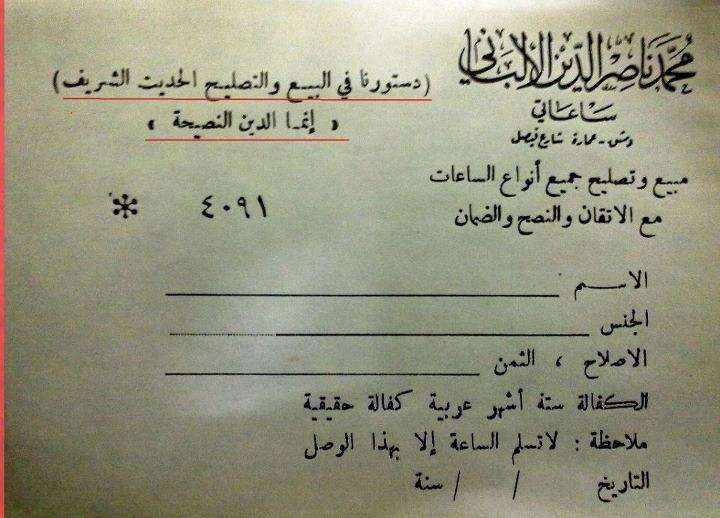
A Picture of a Receipt from the Shop of Al-Albaani the Watch-Repairer


Watch Repair Receipt
Muhammad Naasirud-deen al-Albaani
Horologist
Damascus, Al-Amara district, King Faisal Street
[a famous district and street in Damascus]
Our code [motto] in selling and repairing is the noble hadith,
“The religion is to sincerely advise.”
Sale and Repair of all Types of Watches
With Precision, Sincere Advice, and Guaranteed
Name:
Sex [/or maybe type of watch]:
Repair and cost:
Guaranteed for six Arabic months, with a real warranty.
Note: Watches will not be returned except with this receipt.
Date:        /         /        year

The Shaikh on the Hadith, “Du’aa is worship …”


Explaining the hadith, “Du’aa is worship …” Shaikh al-Albaani, may Allaah have mercy on him said, “And there is no doubt that arrogantly refusing to worship and supplicate to Him, the Most High, necessitates His Anger against the one who does not call on Him … and some of the ignorant Sufis are ignorant or feign ignorance of these hadiths under the assumption that supplicating to Allaah is to show bad manners to Him, being affected in that by the Israa’ili narration, ‘His Knowledge of my condition suffices me from having to ask!’  So they were ignorant of the fact that a servant supplicating to his Lord is not in order to inform Him of his need, for He, “… knows the secret and what is [even] more hidden,” [Taa Haa 20:7] but rather that it is in order for him to manifest his servitude [to Allaah], his need of Him and his destitution [before Him].”
As-Saheehah, 6/326.

Al-Albaani’s Daughters Mentioning Their Father’s Answer to a Question About Memorising the Quraan


In their book, Hassaanah and Sukainah, the daughters of Shaikh al-Albaani said, “And our father, may Allaah have mercy on him, was asked, ‘If I have memorised a quarter of the Quraan and then I move on to the second quarter [but] I haven’t memorised the previous quarter properly, will I be sinful?’ So he replied, ‘You won’t be sinful inshaa Allaah, but you would not have responded appropriately to the Prophet’s صلى الله عليه وسلم saying, “Keep refreshing your knowledge of the Quraan, for by the One in Whose Hand is the soul of Muhammad, it is more inclined to escape than a camel from its rope,” [Muslim] in this hadith is an encouragement to refresh one’s knowledge of the Quraan and to be persistent in reciting it, because it escapes from the breasts of men due to the loftiness of Allaah the Mighty and Majestic’s Speech and its exaltedness.’”
Ad-Daleel ilaa Ta’lim Kitaabil-Laahil-Jalil, vol.3, p. 127.