Saturday, June 30, 2012

Word of the Day, Issue #060


council, an assembly = (majlis) مَجْلِس

Plural: مَجَالِس 
Associated verb: to sit جَلَسَ (يَجْلِسُ) - جُلُوْسًا

Examples

يَا أَيّهَا الّذِينَ آمَنُوا إِذَا قِيلَ لَكُمْ تَفَسّحُوا فِي الْمَجَالِسِ فَافْسَحُوا يَفْسَحِ اللَّهُ لَكُمْ O ye who believe! When ye are told to make room in the assemblies, (spread out and) make room: (ample) room will God provide for you - Quran, 58:11
عَنْ أَبِي مُوسَى ، أَنّ رَسُولَ الله صَلّى الله عَلَيْهِ وَسَلّمَ قَالَ : إِذا مَرّ أَحَدُكُمْ فِي مَجْلِسٍ أَوْ سُوقٍ ، وَبِيَدِهِ نَبْلٌ ، فَلْيَأْخُذْ بِنِصالِهَا ، ثُمّ لِيَأْخُذْ بِنِصالِهَا ، ثُمّ لِيَأْخُذْ بِنِصالِهَا On the authority of Abu Musa, that the Prophet, God bless him and grant him peace, said, "When one of you passes through an assembly (of people) or a market, and he is holding arrows, let him grasp them by their arrow-head, again let him grasp them by their arrow-head, again let him grasp them by their arrow-head" - Muslim
حَلّ مَجْلِسُ الوُزَرَاءِ الْبَاكِسْتَانِيّ بَعْدَ الْحُكْمِ بِعَدَمِ أَهْلِيّةِ رَئِيْسِهِ The Pakistani cabinet (lit. the council of ministers) has been dissolved following the judgement against the eligibility of its Prime Minister - BBC News, Arabic

Did you know...

مَجْلِس is an example of a noun of place and time, which are formed by taking the root letters of a verb (in this case جلس ), and putting them on the morphological template مَفْعَل or مَفْعِل . So literally مَجْلِس means the the sitting-place. By extension (in this, case, synendoche, which is a type of figure of speech which, amongst other things, can be used to refer to the contents of a thing by their container, e.g. "would you like a cup", where "cup" is being used for "cup of tea"), it can also mean the people, or the gathering, at a particular sitting place, and hence an assembly.

Featured Content


Word of the Day, Issue #061


Word of the Day, Issue #061

to stand, rise = (qaama) قَامَ (يَقُوْمُ) - قِيَامًا

Associated adjective: standing قَائِم

Examples

إِنّ الْمُنَافِقِينَ يُخَادِعُونَ الله وَهُوَ خَادِعُهُمْ وَإِذَا قَامُوا إِلَى الصّلاةِ قَامُوا كُسَالَى يُرَاءُونَ النّاسَ وَلَا يَذْكُرُونَ الله إلا قَلِيلًا Lo! the hypocrites seek to beguile God, but it is He Who beguileth them. When they stand up to worship they perform it languidly and to be seen of men, and are mindful of God but little; - Quran, 4:142
عَنْ أَبِي هُرَيْرَةَ أَنّ رَسُولَ الله صَلّى الله عَلَيْهِ وَسَلّمَ قَال : مَنْ قَامَ رَمَضَانَ إِيْمَانًا واحْتِسَابًا ، غُفِرَ لَهُ مَا تَقَدّمَ مِنْ ذَنْبِهِ On the authority of Abu Hurayrah, that the Messenger of God, God bless him and grant him peace, said, "Whoever stands (for prayer in the nights) in Ramadan, his past sins will be forgiven." - al-Bukhari
لِمَاذا قَامَتِ الثّورَاتُ الْعَرَبِيّةُ وَهَلْ مُحَرّكُها هُوَ ظُلْمُ الشّعُوْبِ ؟ Why did the Arab revolutions arise, and was the driving factor the oppression of the people? - al-Jazeera, Arabic

Did you know...

قَام is very often used with the prepositional complement ب , which changes its meaning to to undertake something, e.g. قَامَ بِالأَمْر he undertook the affair, and قَامَ بِالْيَتِيْم he took charge of the orphan.

Featured Content


Friday, June 29, 2012

A Practical Illustration of the Quality of Al-Amaanah (Returning the Trust) From Abdullah Ibn Al-Mubaarak


Al-Hasan bin Arafah said:
Ibn al-Mubarak said to me, "I borrowed a pen in the land of Shaam and then went to return it. However, when I approached Marw (after leaving Shaam), I noticed it was still with me [he must have forgotten]. So I returned to Shaam until I returned it to its owner."
Al-Siyar of al-Dhahabi (8/395).

Updated schedule for the lessons at Darul Qura'an wal Hadeeth Perlis Malaysia


Teacher: Brother AHMAD BANAJAH
(Ahmad Ibn Umar Ibn Abdurrahman Banajah al-Hadrami al-Yemeni)
Language: ENGLISH
Latest timetable has been updated on 6 Sha'baan 1433 , corresponding to the 26th of June, 2012 م
Note: Local Malaysian Time is +8GMT
Timetable For The Duroos
GENERAL CLASS

LESSONS
DAY
LOCAL TIME
BULOOGH UL MARAM
MONDAY-WEDNESDAY
8.00 p.m – 9.00 p.m
       MUHADARAH
FRIDAY
8.00 p.m – 9.00 p.m
           MANHAJ
SUNDAY
  1.30 p.m - 2.00 p.m
Attend the class through the following route:  *PALTALK: RELIGION & SPIRITUALITY>ISLAM>DARUL QURAN WAL HADEETH PERLIS MALAYSIA 

CLASS FOR SISTERS (ENGLISH)

LESSONS
DAY
LOCAL TIME

FIQH

WEDNESDAY & THURSDAY

6.30 p.m -    7.00 p.m

 THESE DUROOS ARE ASLO CONDUCTED VIA PALTALK. PLEASE FOLLOW THE SAME ROUTE ABOVE TO ENTER THE CLASS
---- 

Jazakallahu Khair 

Saturday, June 9, 2012

Numerous Bid’ah (Innovation) in the Month of Rajab


بِسۡمِ ٱللهِ ٱلرَّحۡمَـٰنِ ٱلرَّحِيمِ
 إِنَّ عِدَّةَ الشُّهُورِ عِنْدَ اللَّهِ اثْنَا عَشَرَ شَهْراً فِي كِتَابِ اللَّهِ يَوْمَ خَلَقَ السَّمَاوَاتِ وَالْأَرْضَ مِنْهَا أَرْبَعَةٌ حُرُمٌ ذَلِكَ الدِّينُ الْقَيِّمُ فَلا تَظْلِمُوا فِيهِنَّ أَنْفُسَكُمْ
“Verily, the number of months with Allaah is twelve months (in a year), so it was ordained by Allaah on the Day when He created the heavens and the earth; of them four (Dhul-Qadah, Dhul-Hijjah, Muharram and Rajab) are Sacred. That is the right religion, so wrong not yourselves therein.” 9:36
All praise is due to the Rabb of the worlds, and May Allaah exalt the mention on His chosen Prophet Muhammad (sallallaahu `alayhe wa sallam), and upon his family, his Companions, and those who truly follow them until the Day of Judgment.
Allaah has commanded us to give special attention to the sanctity of these four months (Dhul-Qadah, Dhul-Hijjah, Muharram and Rajab), and refrain from committing sins in them and not to violate the laws of Allaah, upon us is to respect and honor the sacred months. However, we find numerous innovations widespread among the general masses especially with regards to the month of Rajab.
Aayesha (radi allaahu anha) reported : the Messenger of (sallallaahu `alayhe wa sallam) said : “Whoever innovates something in this matter of ours [i.e., Islam] that is not a part of it, will have it rejected.” (Related by both Imaam Al-Bukhari & Imaam Muslim) In another narration “Whoever does an action which is not a part of this matter of ours will have it rejected.” (Related by Imaam Muslim)
The various innovations which are common in this sacred month of Rajab :
  1. Celebrating Prophet’s Night Journey (Isra' and Mi'raaj)
  2. Kunday (Preparing & Distributing kheer puri)
  3. Performing Salaat al-Raghaaib
  4. Observing Voluntary Fast
  5. Visiting Graves 
  6. Frequently Performing Umrah
Now, let us examine the reality of the above practices.
This innovation takes place during the twenty-seventh night of Rajab with extra acts of worship such as Qiyaam al-Layl (voluntary night prayer). In some celebrations you will also find haram (forbidden) acts such as mixing of men and women, singing and music. It is a fact that there is no authentic proof that the Isra’ and Mi’raaj happened on this date according to many great scholars,  Further, even if it were proven, there is no excuse for holding celebrations on this date, because nothing of the kind has been reported from the Prophet (sallallaahu `alayhe wa sallam) or from his companions, may Allaah be pleased with them, or from any of the Salaf (early generations) of this Ummah. If it were a good thing, they would surely have done it before us.
2. Konday (Preparing & Distributing kheer puri)
Distributing special type of Sweets among friends, neighbors and relatives after reciting some verses and prayers on them. This practice is very common in Indian subcontinent, based on a fabricated story which as no base in the deen of Allaah.
3. Salaat al-Raghaaib
This prayer has been introduced in the month of Rajab, done on the night of the first Friday in Rajab, between Maghrib and ‘Isha’, and is preceded by fasting on the first Thursday of Rajab. Salaat al-raghaaib was first introduced 480 AH. There is no authentic report that the Prophet (sallallaahu `alayhe wa sallam) did it, or any of his companions, or any of the best generations or Imaams. This alone is sufficient to prove that it is a reprehensible innovation.
The scholars of Ahlus-Sunnah have warned against it and pointed out that it is innovation and misguidance.
Imaam Ibn al-Haaj (rahim'ullaah) said in al-Madkhal (1/294) “Among the innovations that have been introduced in this noble month (i.e., Rajab) is that on the night of the first Friday thereof, they pray Salaat al-Raghaa’ib in the mosques, and they gather in some mosques and do this innovation openly in the mosques with an imam and congregation, as if it is a prescribed prayer… the view of Imaam Maalik (rahim'ullaah) is that it is makrooh to do this prayer, because it was not done by those who came before, and all goodness is to be found in following them (may Allaah be pleased with them). End quote.
Imaam Al-Nawawi (rahim'ullaah) said in al-Majmoo’ (3/548) “The prayer which is known as Salaat al-Raghaaib, which is twelve rakahs that are offered between Maghrib and ‘Isha’ on the night of the first Friday in Rajab, and praying one hundred rakahs on the night ofNusf Shabaan (halfway through Islamic month Shabaan) are both reprehensible innovations. No one should be deceived by the fact that they are mentioned in Qoot al-Quloob and Ihya’ ‘Uloom al-Deen, or by the hadeeth which is quoted in these two books, because all of that is false. No one should be deceived by some of those Imaams who were confused about the ruling on these prayers and wrote essays stating that they are mustahabb(recommended), for they are mistaken in that. Imaam Abu Muhammad ‘Abd al-Rahmaan ibn Isma’eel al-Maqdisi wrote a valuable book showing that they are false, and he did well in that, may Allaah have mercy on him”. End quote.
4. Observing Voluntary Fast
There is no saheeh (authentic) report from the Prophet (sallallaahu `alayhe wa sallam) or from the Sahaabah to indicate that there is any particular virtue in fasting during Rajab. The fasting that is prescribed in Rajab is the same as that prescribed in other months, namely fasting on Mondays and Thursdays, and the three days of al-Beed, fasting alternate days.
Umar (radi allaah anhu) used to forbid fasting in Rajab because it involved resemblance to the Jaahiliyyah (Ignorance). It was reported that Kharashah Ibn al-Harr said : I saw Umar (radi allaah anhu) smacking the hands of those who fasted in Rajab until they reached out for food, and he was saying, This is a month which was venerated in the Jaahiliyyah. refer : al-Irwaa’, 957; Shaykh Albaani (rahim'ullaah) said : it is saheeh
Haafiz Ibn Hajar (rahim'ullaah) said : ”No saheeh hadith that may be used as evidence has been narrated concerning the virtues of the month of Rajab or fasting this month or fasting in any specific part of it, or observing Qiyaam al-Layl specifically during this month. Imaam Abu Ismaaeel al-Harawi al-Haafiz has already stated this before me, and we have narrated this from others also.” refer : tabayyun al-Ajab bimaa wurida fi fadl rajab
5. Visiting graves
Many people visit graves specially in Rajab, with the belief that it brings goodness to those there in and it’s an act of greater reward, but there is absolutely nothing in Shar’iah(Islamic Law) that recommends such an act, and doing so does not entail any reward better than that entailed by visiting graves on any other ordinary day.
6. Performing Frequent Umrah
There is no report to prove that the Prophet (sallallaahu `alayhe wa sallam) performed Umrah in Rajab, rather that was denied by Aayesha (radi allaahu anha), who said :” The Messenger of Allaah (sallallaahu `alayhe wa sallam) never performed Umrah in Rajab” Narrated in Bukhaari, 1776; Muslim, 1255
Shaykh Muhammad Ibn Ibraaheem (rahim'ullaah) said in his Fataawaa : “As for singling out some of the days of Rajab for any kind of good deed, ziyaarah (visiting the House of Allaah, the Kabah) or anything else, there is no basis for this, because Imaam Abu Shaamah stated in his book al-Bida wa’l-Hawaadith : specifying acts of worship at times that were not specified by Shar’iah is wrong; no time is to be regarded as better than any other except in cases where the Shar’iah  gave preference to a certain act of worship at a certain time, or stated that any good deed done at this time is better than good deeds done at other times. Hence the scholars denounced the practice of singling out the month of Rajab for doing Umrah frequently.”
We ask Allaah to protect us from all types of innovations and make us amongst those who correctly follow the Sunnah of Allaah’s Messenger (sallallaahu `alayhe wa sallam).
 “And whosoever contradicts and opposes the Messenger Muhammad (sallallaahu 'alayhi wa sallam) after the right path has been shown clearly to him, and follow other than the believers way, We shall keep him in the path he has chosen, and burn him in the hell-what and evil destination (4 : 115)

Seek Knowledge First and Leave Off Tabdee' for Now - Shaykh Saalih Al-Fawzaan


بسم الله الرحمن الرحيم
In the Name of Allah, the Extremely Merciful, the Bestower of Mercy

Answered by Ash-Shaykh Al-`Allaamah Saalih Al-Fawzaan (may Allah preserve him)

Question:
What are the rules and regulations through which a scholar determines and is able to say, "Such and such a person is a Mubtada`ee (a person of innovation)," and is every person who commits a bid`ah regarded as a Mubtada`ee(an innovator)?

Answer:
First of all, seek knowledge. Seek knowledge, and leave off Tabdee`(calling people innovators) and busying yourselves with this matter which you have not reached (i.e. have knowledge of) at this stageSeek knowledge, and afterwards you will come to know what bid`ah is and what the Sunnah is. Yes.

Seek Knowledge First and Leave Off Tabdee' for Now - Shaykh Saalih Al-Fawzaan


بسم الله الرحمن الرحيم
In the Name of Allah, the Extremely Merciful, the Bestower of Mercy

Answered by Ash-Shaykh Al-`Allaamah Saalih Al-Fawzaan (may Allah preserve him)

Question:
What are the rules and regulations through which a scholar determines and is able to say, "Such and such a person is a Mubtada`ee (a person of innovation)," and is every person who commits a bid`ah regarded as a Mubtada`ee(an innovator)?

Answer:
First of all, seek knowledge. Seek knowledge, and leave off Tabdee`(calling people innovators) and busying yourselves with this matter which you have not reached (i.e. have knowledge of) at this stageSeek knowledge, and afterwards you will come to know what bid`ah is and what the Sunnah is. Yes.

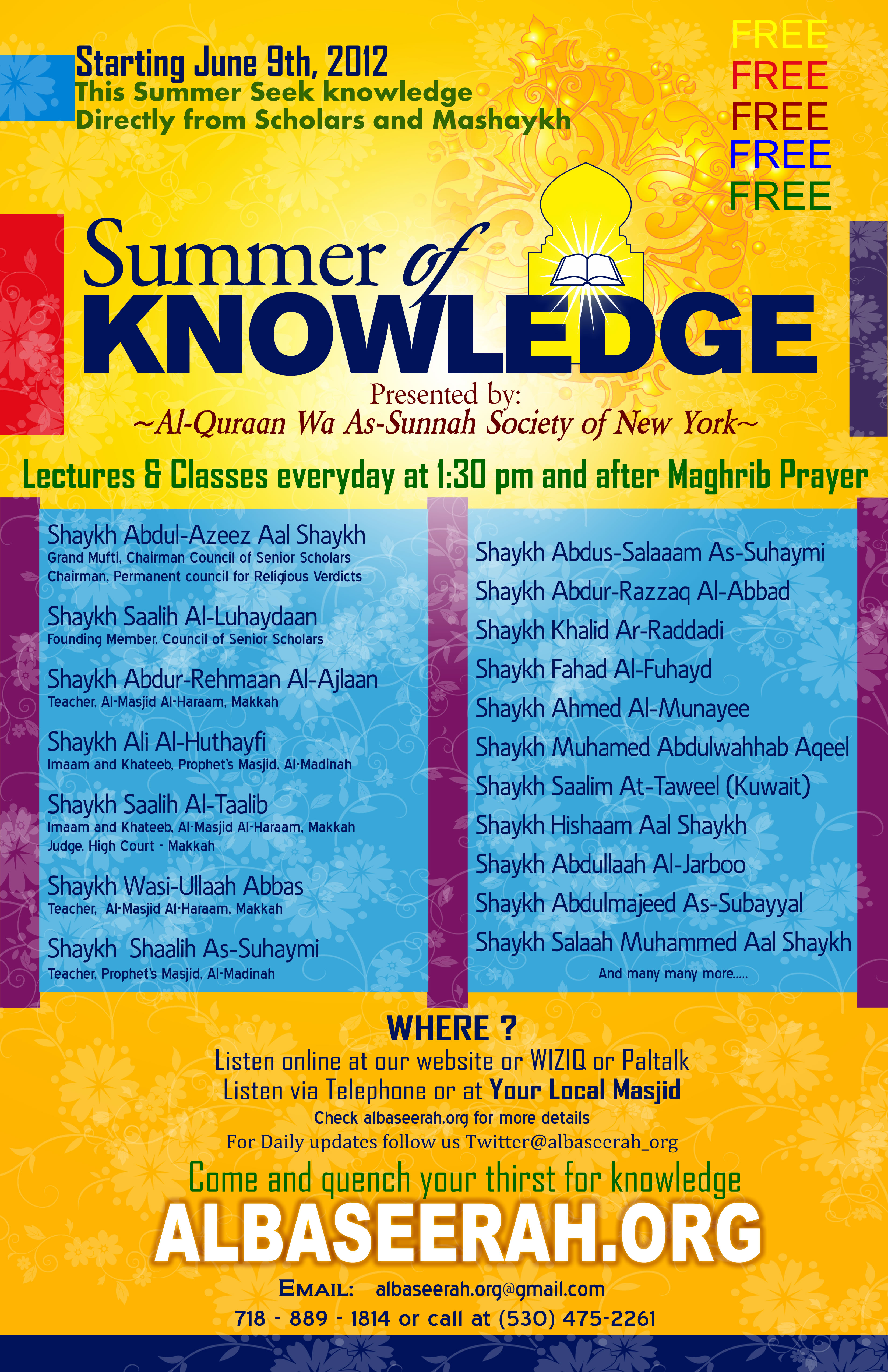
A Golden Opportunity - Summer of Knowledge with Scholars - Daily Lectures with Senior Scholar

Is Changing My Name a Must? – Shaykh Ahmad Bazmool


Author: Shaykh Ahmad ibn ‘Umar Baazmool (hafidhahullaah Ta’aala)
Questions posed by Anwar Wright & Abu Yusuf Khaleefah, Translated by Anwar Wright
http://www.salafyink.com/studentsofknowledge/QAShBazmool1.pdf
Question:
From those understandings that we have amongst us is: if a person accepts Islam, it is said to him "Pick an attribute for yourself" and that which they mean is that one changes their name (to a Muslim name) and they say for example, you are a person who is generous (kareem) or you have generosity, so you are Abdul- Kareem (servant of the Most Generous) or you are a person who is aware and experienced about things so you are 'Abdul-Khabeer (servant of the All-Aware), so is this the correct understanding regarding picking a name?
Answer:
There is no objection in changing one's name if the name holds some type of evil meaning or even if a person wanted to change his name and it didn't hold an evil meaning. There is no objection to this; this is the first thing. Secondly, if the name is suitable and it doesn't oppose Islam in any way, and these individuals always change the names, we say to them: No, stop! Because the Prophet - salla Allaahu alayhi wa sallam - didn't change the name of everyone who accepted Islam. He only changed some names due to a wisdom that necessitated that like. For example, if the name held a meaning that exceeded the bounds of the legislation. So it is not from the Sunnah to do the likes of this affair.
Also the affair of looking if a person is kareem (generous), then he is called Abdul- Kareem, then it is not a must that a person picks a name that starts with 'Abd (i.e. slave of), for the Prophet - salla Allaahu alayhi wa sallam - said the best of names are 'Abdullah and 'Abdur-Rahman, and the most truthful of names are Haarith and Hammaam.
So he mentioned some names, even if they aren't preceded by 'Abd. They still are truthful names like Haarith and Hammaam. So it isn't a must that a name contains 'Abd.
The fourth matter is that I fear that it is understood from this matter that there is a Sunnah or that there is guidance from the Salaf regarding this affair and from that which I know, this hasn't been reported from the Salaf in the likes of this fashion, so I fear that it enters into the affairs of newly innovated matters and innovations so this should be left and the names shouldn't be changed except for some wisdom and a legislated excuse.

Friday, May 25, 2012

MENTIONING THE NAME OF ALLAAH IN THE BATHROOM source: silsilat ul-hudaa wa nnoor, 224/4 asaheeha translations


Questioner: “What is the ruling on mentioning the name of Allaah before wudhoo in the bathroom?”
Shaikh al-Albaani: “You mean for example in a small room, two by two meters, with a toilet on one corner and a washbasin on the other side in which you make wudhoo?”
Questioner: “Yes.”
Shaikh al-Albaani: “There is no problem with that at all, because the problem is only with mentioning Allaah (‘azza wa jal) during the time he is sitting to relieve himself. This is the forbidden thing. But if he has finished and cleaned himself, and goes to the washstand and must mention the name of Allaah at that time, then there is nothing (wrong) in that, because this place is not the toilet, (rather) it is the bathroom. The toilet is in the corner; so if one sits there to relieve himself, then during this sitting it is forbidden for him to mention Allaah (‘azza wa jal). Otherwise, just before that – before raising his garment – he must mention the name of Allaah, he must seek refuge in Allaah. So if he sits to relieve himself, it is forbidden for him to mention Allaah (‘azza wa jal). When he finishes, what does he say? ‘Ghufraanaka.’ When he has said that and steps toward the other side of the bathroom, then he can mention Allaah and say whatever adhkaar he wants.”


Tablighi Jamaat is in need of Dawah
By Shaykh Abdul Muhsin Al Abaad
Question:
The final question, is it permissible for us to prevent Tablighi Jamaat from giving dawah in our Masjid?
Shaykh Abdul Muhsin:
Tablighi Jamaat is in need of dawah, they need to be given dawah, and enlighten, with Tawheed and Aqeedah, and with what the Salaf of this Ummah were upon. Therefore, you give them dawah and enlighten them, and direct them to that which is correct because they are overcome with ignorance. Therefore help them to reach the good and give them understanding in the religion.


Warning from innovations of Rajab-Dr Hamad Al-Haajiree (Kuwait)

As salamu alykum wa rahmatul-llahi wa barakaatuhu, 

Please download the attachment or long on this link below: 

http://www.4shared.com/office/xqoh3_wO/Warning_from_innovations_of_Ra.html

Feel free to share it or re-post it. Baarakal-llahu feekum

Monday, May 21, 2012

What is required of a new Muslim between the period he embraces and openly announces his religion


Question:
Between the period he embraces Islaam and [openly] announces his [embracing of] Islaam, is the new Muslim required to perform the obligatory acts as required of [all] Muslims?
Response:
All Praise be to Allaah alone, and may the prayers and salutations be upon His Messenger and his companions; To proceed:
When a person embraces Islaam, then [as a Muslim] - according to his ability - he is [now] required to gradually learn that which is required of him - as legislated. He is [then] required to act accordingly, and that is from the date he embraced Islaam.
And with Allaah lies all success and may Allaah send prayers and salutations upon our Prophet (sal-Allaahu 'alayhe wa sallam) and his family and his companions.

The Permanent Committee for Islaamic Research & VerdictsFataawa al-Lajnah ad-Daa.imah lil-Buhooth al-'Ilmiyyah wal-Iftaa - Fatwa No.6348
Fataawa ad-Da'wah wal-Jamaa'aat al-Islaamiyyah - Page 85

What is required of a new Muslim between the period he embraces and openly announces his religion


Question:
Between the period he embraces Islaam and [openly] announces his [embracing of] Islaam, is the new Muslim required to perform the obligatory acts as required of [all] Muslims?
Response:
All Praise be to Allaah alone, and may the prayers and salutations be upon His Messenger and his companions; To proceed:
When a person embraces Islaam, then [as a Muslim] - according to his ability - he is [now] required to gradually learn that which is required of him - as legislated. He is [then] required to act accordingly, and that is from the date he embraced Islaam.
And with Allaah lies all success and may Allaah send prayers and salutations upon our Prophet (sal-Allaahu 'alayhe wa sallam) and his family and his companions.
The Permanent Committee for Islaamic Research & VerdictsFataawa al-Lajnah ad-Daa.imah lil-Buhooth al-'Ilmiyyah wal-Iftaa - Fatwa No.6348
Fataawa ad-Da'wah wal-Jamaa'aat al-Islaamiyyah - Page 85

PRINCIPLES Charts added… by sarf4sisters


Bismillaah
Two new documents have been added to the Resources page with easy step by step explanation for conjugating verbs that have special cases.  We ask Allaah to reward the student who provided these charts with the best of rewards -

PRINCIPLES 1

(fi`lul-mudhaari` an-naaqis)

PRINCIPLES 2

(fi`lul-maadhee an-naaqis)

PRINCIPLES Charts added… by sarf4sisters


Bismillaah
Two new documents have been added to the Resources page with easy step by step explanation for conjugating verbs that have special cases.  We ask Allaah to reward the student who provided these charts with the best of rewards -

PRINCIPLES 1

(fi`lul-mudhaari` an-naaqis)

PRINCIPLES 2

(fi`lul-maadhee an-naaqis)

The Incredible Story of “The Lamp”


Anas bin Malik narrated: The Messenger of Allaah said: «A good dream [that comes true] of a righteous man is one of forty-six parts of prophethood.» Transmitted by al-Bukhaaree - v.9, p.30
Abu Qataadah narrated: The Prophet said: «A true good dream is from Allaah, and a bad dream is from Shaytaan.» Transmitted by Muslim - v.4, p.1772
Abu Hurayrah narrated: I heard the Messenger of Allaah saying: «Nothing is left of the prophethood except Al-Mubashshiraat.» They asked, "What are Al-Mubashshiraat?" He replied: «The true good dreams [that conveys glad tidings].» Transmitted by al-Bukhaaree - v.9, p.31
A man narrates:
My father once narrated [a story to me] about an old man who had a dream. In this dream, he met Shaykhul-Islaam Ibn Taymiyyah in one of the markets of 'Unayzah; It was one of the markets which leads to the assembly (a gathering place) – a well known place in 'Unayzah.
During this meeting, Shaykhul-Islaam Ibn Taymiyyah handed a lamp to this old man.
When the old man [later] enquired about the [meaning of his] dream, he was told that he will have a child who would [grow up to] be pious (saalih) and he would have [an elevated] stature in [islaamic] knowledge.
So, a child was born to this old man, and he was set upon naming him Saalih, in the hope that his dream would be true and specific to this child.
So, Saalih was religious and devout, and loved the people, [just] as they loved him [too]. He would recite the Qur.aan and stand the night in prayer, however, he was not a student of knowledge.
Saalih then got married and had a son, whom he named Muhammad; He was Muhammad ibn Saalih al-'Uthaymeen.
And in reality - and we consider him as such - he was the lamp which Shaykhul-Islaam Ibn Taymiyyah had given the old man [in the dream].
And [as for] this old man, [well, he] was the grandfather of Shaykh Ibn 'Uthaymeen – may Allaah have mercy upon him.
Narrated by: The Shaykh's son, 'Abdullaah ibn Muhammad ibn Saalih al-'Uthaymeen.

Ibn Baaz … “Before His Death He Woke Up From Sleep …”


Abdur-Rahmaan ibn Abdul-Aziz ibn Baaz said, “Before his death he woke up from sleep and performed ablution and spread out his prayer mat and started to say, ‘Laa ilaaha illallaah’ and ‘Allaahu Akbar,’ and then he tried to go back to sleep again but he felt some difficulty in breathing so we called an ambulance and while we were taking him to the hospital, he died on the way, and we praise Allaah for his Pre-Decree and its execution [al-Qadar wal-Qadaa].”

Mawaaqif Mudee’ah, p. 119

Your Degree in the Sight of Allaah


Ibn al-Qayyim:

The worker, who wants to know his degree in the master’s eye, should first observe how much he works for him.

al-Fawaa`id


BismillaahirRahmaanirRaheem

AsSalaamu'alaikumwarahmatullaahiwabarakaatuhu

Please find transcript of lesson 44 of Usool-uth-Thalaathah now uploaded.

Jazaakumullaahu khairan

wassalaam

Al-Albaani and His Bicycle: The Turbaned Shaikh was the Talk of the Town by The Albaani Blog


He said, “I bought a bicycle to ride and it was the first time the Damascenes saw such a spectacle: a turbaned Shaikh riding a bicycle!
They were astonished at such a sight.
There used to be a magazine called Al-Mudhik al-Mubkiwhich a Christian man would publish, he mentioned this incident among the witty jokes [therein, but] I wouldn’t care about these petty issues–all that concerned me was time.”
1 A comedic magazine published in Damascus by a journalist called Habeeb Kahaalah.  In each edition he would print a picture which would be the talk of the town for the whole week.
Al-Imaam al-Albaani, Duroos, wa Mawaaqif, wa Ibar, of Abdul-Aziz ibn Muhammad Abdullaah as-Sadhaan, p. 111.

Is It Okay to Go Out for Da’wah [Khuruj] with the Tablighi Jamaa’ah? by The Albaani Blog


Questioner: If I have turned to [wanting to practise] the religion and have no knowledge and an Islamic group asks me to go out with them for da’wah and some brothers at the mosque warn me stating that this jamaa’ah is called the Tableeghi Jamaa’ah and it is not right for me to go out with them because they have corrupt beliefs, what should I do?
Al-Albaani: Seek knowledge, what’s the problem, seek knowledge.
Questioner: Ya’ni, is it permissible for me to go out with them now?
Al-Albaani: Their going out is not from the Sunnah. Their sitting in the mosques and seeking knowledge and studying the Book of Allaah as occurs in the authentic hadith, that is what is legislated. As for their going out like this in groups, and most of them only know very little about Islaam, this is something which they have opposed the Muslims from the time of the Prophet to this day in.
Before this time, thirty or forty years ago, there was no Jamaa’ah that would go out like this with tens or hundreds of people without even a single scholar found amongst them.
The people of knowledge are widespread in Jordan and Syria and we advise these people to sit in the gatherings of knowledge and to learn, and this is what we advise you with too. We say to you: attend the gatherings of knowledge, the sittings of knowledge and learn.
As for this going out [khuruj]–it has no basis in the Sunnah.
Al-Hudaa wan-Noor, 81.

Contentment


Shaikh Uthaimeen, may Allaah have mercy on him said, “From Allaah’s Blessings on a servant is that he be granted contentment, whether that be regarding his residence, his clothes, his means of transport, or his children.
For when a person is content with what Allaah has given him, he will remain rich.”
Bulughul-Maraam, vol. 6, p. 272.

Al-Albaani on His Balcony and The Fig Tree by The Albaani Blog


“There used to be a fig tree in his house in Amman [Jordan], from which he would take figs while seated on his balcony.  He would do so by using a long stick that he had devised where he had split and overlapped it so that he controlled how long or short he wanted it.  At its end he placed a sharp, pointed cup, so that when he touched them with the tip of the stick, the figs would fall into the cup.”
Al-Imaam al-Albaani, Duroos, wa Mawaaqif, wa Ibar, of Abdul-Aziz ibn Muhammad Abdullaah as-Sadhaan, p. 111.

Lets Learn Quran: One to One Sessions for Kids by Successful Beginnings

New One-to-One Session

Teach your child Quran with our experienced and qualified teachers. 


Arabic Alphabets
Joining Letters
Vowels
Nunation
Long Vowels
Silent Letters
Reading Practice
Course materials will be provided

Class Features
  • Live Sessions
  • FREE access to the class recordings
  • Printable course slides, books and worksheets
  • Assignments and Examinations
  • Screen sharing, chat, notes, whiteboard

for an interactive 21st century stylelearning

Upon registration the student will recieve an username, password and direct access to their Virtual Online Classroom.

They will need a working headset with microphone and a computer with internet connection to join their classes.

Complete the form by clicking here and we will arrange for a teacher who can work with your child at a time that is convenient for you!

Are There Companions Who Will be Called to Account and Then Punished and Who Will Then Enter Paradise? by The Albaani Blog


Questioner: Our Shaikh, are there people from the Companions who will be called to account and then punished and who will then enter Paradise? Are any of them of such levels?
Al-Albaani: Why are you concerned about that? [Lit: what concerns you about that question?]
Questioner: Wallaahi, it’s a question that came to mind.
Al-Albaani: I don’t think it crossed your mind … [starts laughing]
Questioner: [laughs]
Al-Albaani: From some angles these are whisperings [of the Devil, waswasah] … why are you concerned about that … why are you concerned about that … does it have a connection to your aqidah? [Is it] something which you will correct [your aqidah] with?
Ask about what is relevant to you, Yaa akhi, because this is a door Shaitaan enters through.
Al-Hudaa wan-Noor, 547.